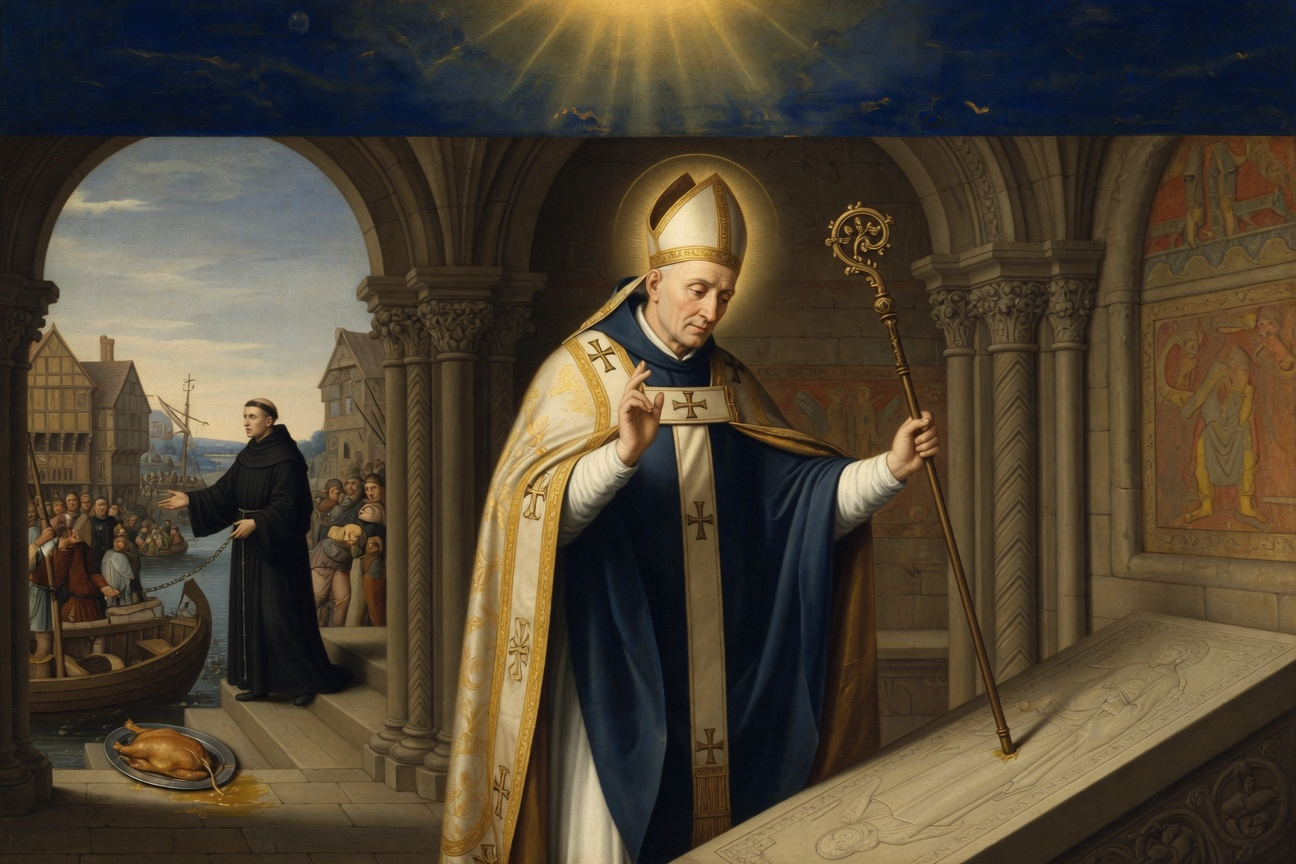
Saint Contest, Bishop of Bayeux
Born near Caen, Saint Contest first withdrew into solitude before becoming Bishop of Bayeux in 456. He distinguished himself by his piety and preaching until his death in 513. His relics were transferred to Fécamp in the 12th century.
Contemporaries

Figures and markers around the normalized period for this entry.
Guided reading
4 reading sections
SAINT CONTEST, BISHOP OF BAYEUX (513).
Origins and solitary life
Born in Athia-sur-Orne, Contest withdrew into solitude to devote himself to prayer in the face of the corruption of his contemporaries.
Born in Athia-sur-Orne, near Cae n, he devoted himself early on to the practices of piety, and, despairing of bringing back to the good his compatriots whose vices and corrupt morals he energetically censured, he withdrew into a solitude where prayer and penance became his only occupations.
Episcopate in Bayeux
Elected Bishop of Bayeux in 456 after the death of Saint Mauvieu, he led an ascetic life and converted many faithful.
His virtues made him judged worthy to ascend to the episcopal see of Bayeux , which had become vacant upon the death of Saint Mauvieu, which occurred on May 28, 456.
In these eminent functions, he changed nothing in his way of life and brought about a great number of conversions through his preaching as much as by his examples.
Death and first burial
The saint died in 513 and was buried in the church of Saint-Exupère, on the site of a future altar dedicated to Saint Clair.
After having combined the qualities of a pious hermit with the virtues of a perfect bishop, he fell asleep peacefully in the Lord on January 19, in the year 513. He was buri ed in the church of Saint -Exupère, to the north and on the site where an altar to Saint Clair was later erected.
Translation of the relics
His relics were transferred to the Abbey of Fécamp in 1162, and a portion was later given to the Priory of Saint-Vigor in 1682.
His relics were solemnly transported, on April 11, 1162, to the Abbey of Fécamp; but the m onks of this convent gave, in 1682, a considerable portion of these precious remains to the poor religious of the Priory of Sa int-Vigor, near Bayeux .
See, in the Supplement of this volume, more complete details on the cult and the relics of this holy Bishop.
Entities
Narrative network
The names, places, and concepts most present in the entry, weighted by centrality in the text.
Frequently asked questions about Saint Contest, Bishop of Bayeux
Who was Saint Contest, Bishop of Bayeux?
Born near Caen, Saint Contest first withdrew into solitude before becoming Bishop of Bayeux in 456. He distinguished himself by his piety and preaching until his death in 513. His relics were transferred to Fécamp in the 12th century.
What is Saint Contest, Bishop of Bayeux the patron saint of?
Patronage of Saint Contest, Bishop of Bayeux: Bayeux.
Which saints were contemporaries of Saint Contest, Bishop of Bayeux?
Contemporaries include: Saint Antide of Besançon, Saint Eugene of Carthage, Saint Nicaise of Reims and Saint Patrick (Patricius).
When did Saint Contest, Bishop of Bayeux die?
Saint Contest, Bishop of Bayeux died around 513.
Annexes & related entities
Structured data for exploration: events, miracles, quotes, places, attributes, patronages, and important entities cited in the text.
Key Events
- Retirement into solitude for prayer and penance
- Election to the episcopal see of Bayeux after the death of Saint Mauvieu
- Preaching and conversions in his diocese
- Peaceful death in 513
- Translation of relics to the Abbey of Fécamp in 1162