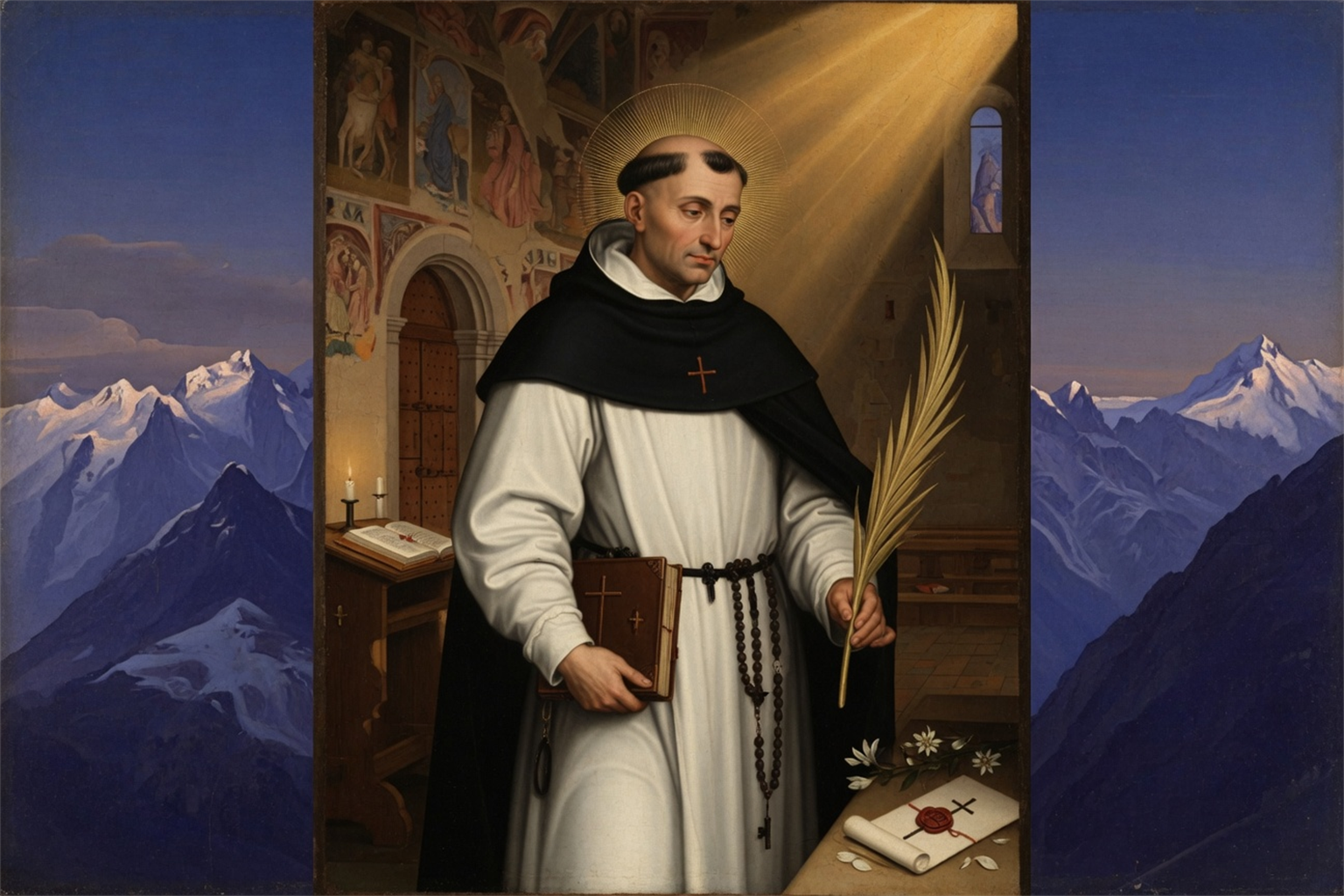
Blessed Pierre Cambian de Ruffie
A Dominican friar appointed inquisitor general in Piedmont in 1351, Pierre Cambian de Ruffie fought against the Albigensian heresy. He was assassinated by a hired killer on the day of the Purification in 1365 at the convent of Susa. His cult was officially confirmed by Pope Pius IX in 1856.
Contemporaries

Figures and markers around the normalized period for this entry.
Guided reading
3 reading sections
BLESSED PIERRE CAMBIAN DE RUFFIE (1365).
Context of the Albigensian heresy
Southern Europe suffered the ravages of the Albigensian heretics in the 12th century, who were opposed by princes and, above all, by Saint Dominic and the Dominicans.
Towards the end of the 12th century, the south of Europe suffered greatly from the heretics known as the Albigensians. Not content with overturning Catholic dogmas, they drove bishops from their sees and burned down monasteries. Christian princes banded together and turned the force of their arms against these public enemies of the State and of religion. But God gave His Church an even more powerful aid in the person of Saint Domini c and his preac hing brothe rs. These holy m en, far more than armies and princes, knew how to preserve a multitude of Catholics and bring back a great number of heretics to the good.
Mission and Martyrdom in Piedmont
Appointed inquisitor general in Piedmont in 1351, Pierre Cambian was assassinated by an Albigensian sicarius in 1365 at the Franciscan convent of Susa.
Heresy disappeared, but its remnants took refuge in the subalpine mountains, and the Sovereign Pontiffs had to send inquisitors into Piedmont. The hatred of the heretics erupted against these religious, several of whom received the palm of martyrdom. Among the martyrs of the Order of Saint Dominic is Blessed Pierre Cambian of Ruffia. This holy man ha d entered religious life at an early age. He was appointed inquisitor general in Piedmont before the pontificate of Innocent VI, in th e year 1351 , and it was in the exercise of his duties that he was martyred by the Albigensians in 1365. He had been sent into the valleys and had received hospitality in the Franciscan convent of Susa. The heretic s, f eari ng the zeal of the inquisitor, sent a sicarius who killed him in the cloister of the convent.
Recognition and cult
The opening of his tomb in 1854 revived popular devotion, leading to the official confirmation of his cult by Pope Pius IX in 1856.
It was the day of the Purification of the Blessed Virgin. The opening of the Blessed one's tomb, in 1854, manifested all the piety with which the faithful surround his memory. The clergy, who had not yet been able to obtain relics, received them with the liveliest demonstrations of joy and placed them on the altars. Our Holy Father Pope Pius IX confirmed the cult of this blessed martyr in 1856.
Iconography
Signs and attributes
Entities
Narrative network
The names, places, and concepts most present in the entry, weighted by centrality in the text.
Frequently asked questions about Blessed Pierre Cambian de Ruffie
Who was Blessed Pierre Cambian de Ruffie?
A Dominican friar appointed inquisitor general in Piedmont in 1351, Pierre Cambian de Ruffie fought against the Albigensian heresy. He was assassinated by a hired killer on the day of the Purification in 1365 at the convent of Susa. His cult was officially confirmed by Pope Pius IX in 1856.
How is Blessed Pierre Cambian de Ruffie depicted in Christian art?
In iconography, Blessed Pierre Cambian de Ruffie is recognizable by: palm of martyrdom and Dominican habit.
How did Blessed Pierre Cambian de Ruffie die?
Blessed Pierre Cambian de Ruffie suffered martyrdom for the Christian faith (14th century).
Which saints were contemporaries of Blessed Pierre Cambian de Ruffie?
Contemporaries include: Saint Peregrinus of Auxerre, Saint Thomas Aquinas, Saint Francis of Assisi (Confessor) and Saint Colette (Nicole).
What are the other names of Blessed Pierre Cambian de Ruffie?
Other forms of the name: Pierre Cambian.
Annexes & related entities
Structured data for exploration: events, miracles, quotes, places, attributes, patronages, and important entities cited in the text.
Key Events
- Early entry into religious life within the Order of Saint Dominic
- Appointed Inquisitor General in Piedmont in 1351
- Mission in the Alpine valleys against the heretics
- Assassinated by a hired killer in the cloister of the Franciscan convent in Susa
- Opening of the tomb in 1854
- Confirmation of cult by Pope Pius IX in 1856