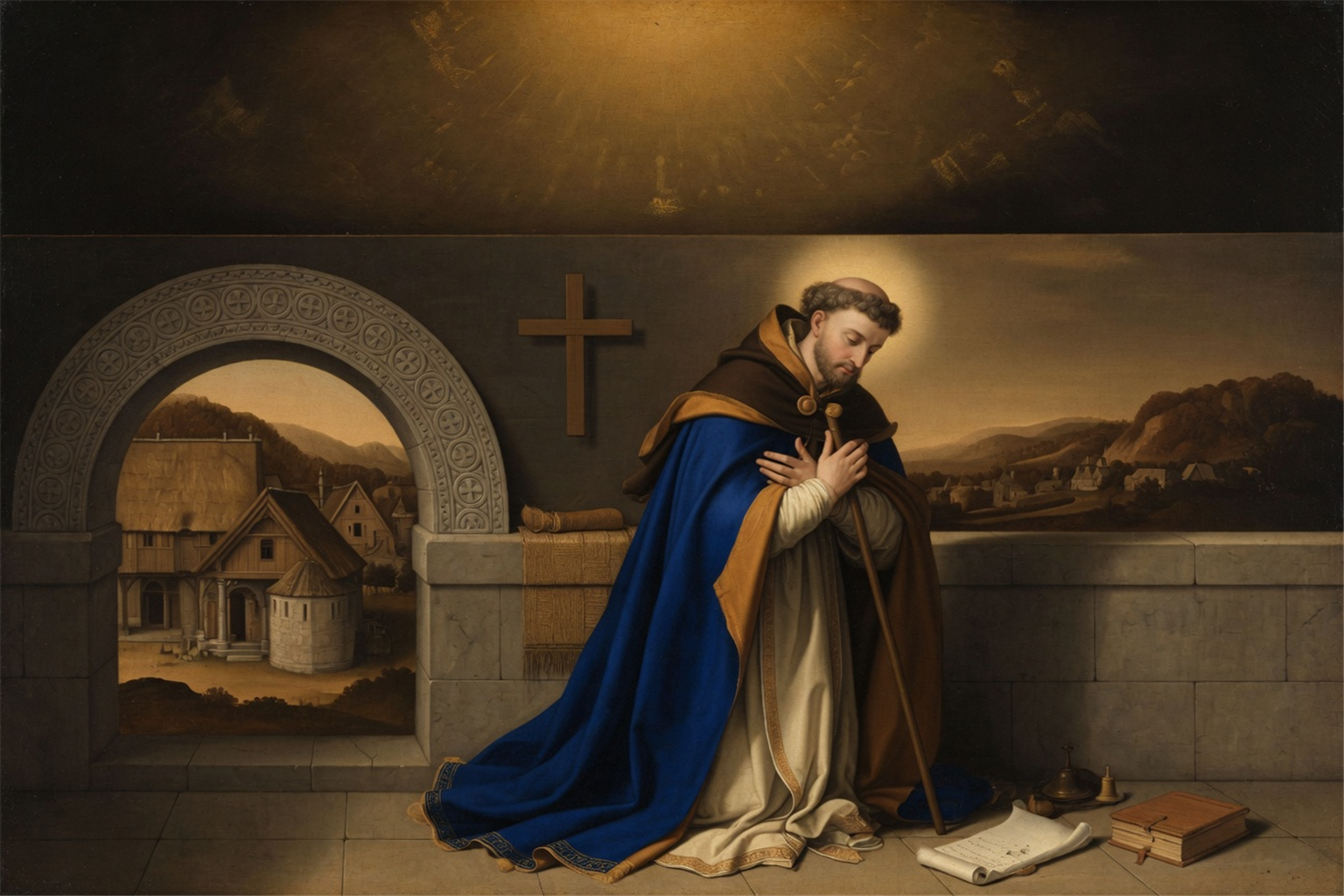
Saint Hadelin of Celles
Originally from Aquitaine, Saint Hadelin was a disciple of Saint Remaclus at Solignac, Cougnon, and then Maastricht. He founded the monastery of Celles near Dinant thanks to the generosity of Pepin the Short. He died in 696, leaving behind a reputation for great holiness and fervor.
Guided reading
4 reading sections
SAINT HADELIN, ABBOT OF CELLES IN THE DIOCESE OF LIÈGE (696).
Origins and monastic formation
Originally from Aquitaine, Hadelin dedicated himself to the religious life at Solignac and then at Cougnon under the direction of Saint Remaclus.
Saint Hadelin , born i n Aquitai ne, left his homeland and all that he possessed in the world to follow Jesus Christ; he embraced penance in the abbey o f Solignac in Limo usin; he then moved to that of Cougnon, located on the Semois river, between Chiny and Bouillon, with Saint Remaclus , his abbot. A few years later, he was obliged to leave his solitude to serve the church of Maastricht, the government of which had been entrusted to Saint Remaclus upon the resignation of Saint Ama nd. The new bishop raised him to the priesthood, in order to give his zeal more scope and activity.
Mission in Maastricht and retirement to Dinant
After serving the church of Maastricht, Hadelin established himself as a hermit near Dinant, quickly attracting disciples.
When Saint Remaclus retired to the abbey of Stavelot, Saint Hadelin followed him there as well: they eventually separated, however. Hadelin went to establish his dwelling near the Lesse river, half a leagu e from Dinant. A few other solitaries soon joined him. All served God with great fervor through prayer, fasting, and vigils.
Meeting with Pepin and the foundation of Celles
Thanks to the support of Pepin the Short and Plectrude, Hadelin founded the monastery of Celles on the site of his hermitage.
The reputation for holiness that Hadelin enjoyed attracted frequent visits to him. Pepin , Mayor of the Palace, came to see hi m with Pl ectrude, his wife; and he gave them both instructions on the vanities of the world, on the greatness of the goods of heaven, and on the obligation common to all men to observe the holy maxims of the Gospel.
The liberality of Pepin and several other lords enabled him to build a monastery, where he gathered his disciples, whom he continued to edify by his virtues. This monastery took the name of Celles, because of t he sma ll cells for which it had been substituted.
Death and translation of the relics
Hadelin died around 696; his relics were later transferred to Visé in 1338 during the relocation of the chapter.
Having fallen ill, Hadelin prepared himself with renewed fervor to appear before God, and exhorted his disciples to occupy themselves ceaselessly with their final moment. He died around the year 696, after having received the holy viaticum. His body was buried at Celles, where, in the course of time, canons were placed in the stead of the religious.
In 1338, the c hapte r was transferred to Visé, a small town situated on the Meuse, between Liège and Maas tricht; the relic s of the Saint were also brought there. His feast is celebrated on October 11 and on the Sunday within the octave of the Nativity of the Blessed Virgin; but it was formerly observed on February 3.
Entities
Narrative network
The names, places, and concepts most present in the entry, weighted by centrality in the text.
Frequently asked questions about Saint Hadelin of Celles
Who was Saint Hadelin of Celles?
Originally from Aquitaine, Saint Hadelin was a disciple of Saint Remaclus at Solignac, Cougnon, and then Maastricht. He founded the monastery of Celles near Dinant thanks to the generosity of Pepin the Short. He died in 696, leaving behind a reputation for great holiness and fervor.