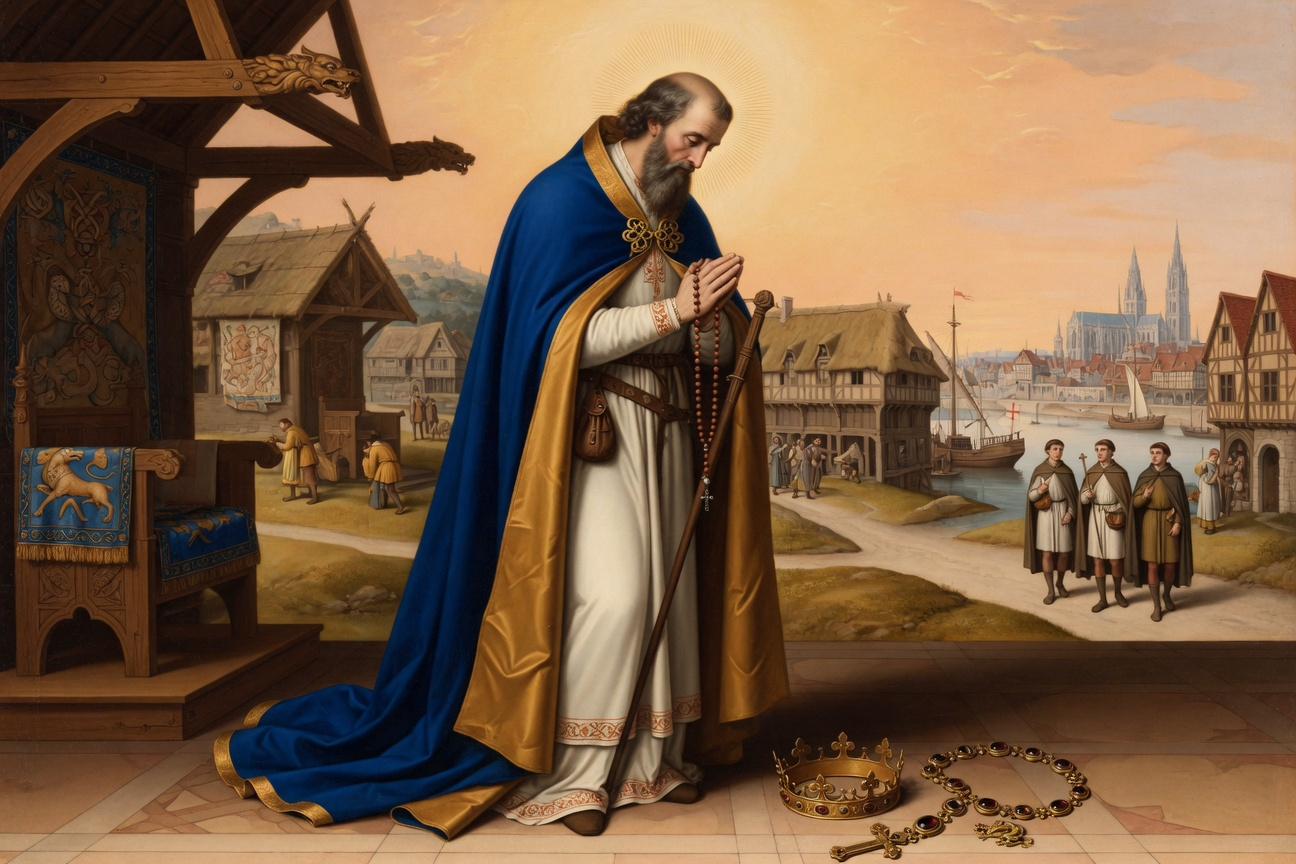
King of the West Saxons in the 8th century, Richard left his throne to undertake a pilgrimage to Rome with his sons. He died on the way in Lucca in 722 before reaching his destination. Father of three famous saints, he is honored for his piety and the miracles that occurred at his tomb.
Contemporaries

Figures and markers around the normalized period for this entry.
Guided reading
5 reading sections
SAINT RICHARD, SAXON KING (722).
8TH DAY OF FEBRUARY
Origins and departure on pilgrimage
Richard, King of the West Saxons and father of three future saints, leaves his throne to undertake a pilgrimage to Rome.
He reigned around the 8th century, among the West Saxons who had settled in England. He was the father of Winebald , Willib ald, and Walb urga, w ho are a ll three venerated as Saints; but, whether he had been deprived of his states by some revolution, or whether he had voluntarily abdicated the crown, he made a pilgrimage to Rome with his sons Winebald and Willibald.
The journey and death in Lucca
After crossing Neustria and staying in Rouen, Richard died suddenly in Lucca in 722 before reaching Rome.
Having embarked at Hamble-Haven, he landed on the coasts of Neustria, from where he traveled to Rouen. After making a fairly long stay in this city, he continued his journey, giving the greatest marks of piety everywhere. He could not reach Rome, and he died suddenly in Lucca, in Italy, ar ound th e year 722. He was buried in the church of Saint Fridianus.
Recognition and Veneration
Miracles attest to his holiness, and his cult developed particularly in Lucca, where he is celebrated on February 7.
The miracles that God had granted to the piety of this prince, and those with which He has since honored his relics, have earned him a place among the Saints. The veneration of Saint Richard is very fam ous in the city of Lucca, which celebrates his feast day on the 7th of February.
Iconography and posterity of his sons
The saint is represented with various royal or pilgrim attributes, while his sons became major figures of the Church in Germany.
He is represented: 1° standing, wearing his insignia. At his feet are his royal crown, a necklace, a rosary, a book; 2° as a pilgrim, healing a crippled man; 3° engaging in his retreat in the labors of plowing; 4° in a group that brings together his two sons Saint Winebaud and Saint Guilbaud (Wunibald and Wilibald) who later went to Germany and became, one, abbot of Heidenheim and the other bishop o f Eichstätt.
Documentary Sources
The life of the saint is documented by ancient writings, notably those of a nun of Heidenheim and the works of scholars.
See the Life of Saint Willibald, written by a nun of Heidenheim, in the Lectiones antiquæ of Canis ius, from the Banninge edition, and Father Henschenius, Feb., vol. II, p. 70.
Iconography
Signs and attributes







Entities
Narrative network
The names, places, and concepts most present in the entry, weighted by centrality in the text.
The supernatural in their life
The miracles of Saint Richard, Saxon King
Frequently asked questions about Saint Richard, Saxon King
Who was Saint Richard, Saxon King?
King of the West Saxons in the 8th century, Richard left his throne to undertake a pilgrimage to Rome with his sons. He died on the way in Lucca in 722 before reaching his destination. Father of three famous saints, he is honored for his piety and the miracles that occurred at his tomb.
What is Saint Richard, Saxon King the patron saint of?
Patronage of Saint Richard, Saxon King: Lucca.
How is Saint Richard, Saxon King depicted in Christian art?
In iconography, Saint Richard, Saxon King is recognizable by: royal insignia, crown at his feet, necklace, rosary, book and pilgrim's habit.
What miracles are attributed to Saint Richard, Saxon King?
2 miracles are attributed to this saint, notably: Healing and Sign / wonder.
Which saints were contemporaries of Saint Richard, Saxon King?
Contemporaries include: Saint Hidulph of Trier, Saint Ghislain (Guillain), Saint Lambert (Landebert) and Saint Amand of Maastricht.
When did Saint Richard, Saxon King die?
Saint Richard, Saxon King died around 722.
Who are the relatives of Saint Richard, Saxon King?
Relatives of Saint Richard, Saxon King: Winebaud (Wunibald) (son), Guilbaud (Wilibald) (son) and Walburge (daughter).
Annexes & related entities
Structured data for exploration: events, miracles, quotes, places, attributes, patronages, and important entities cited in the text.
Key Events
- Reigned over the West Saxons in England
- Abdication or loss of the throne
- Pilgrimage to Rome with his sons
- Landing at Hamble-Haven and passage through Neustria (Rouen)
- Sudden death in Lucca