Saint Castor of Koblenz
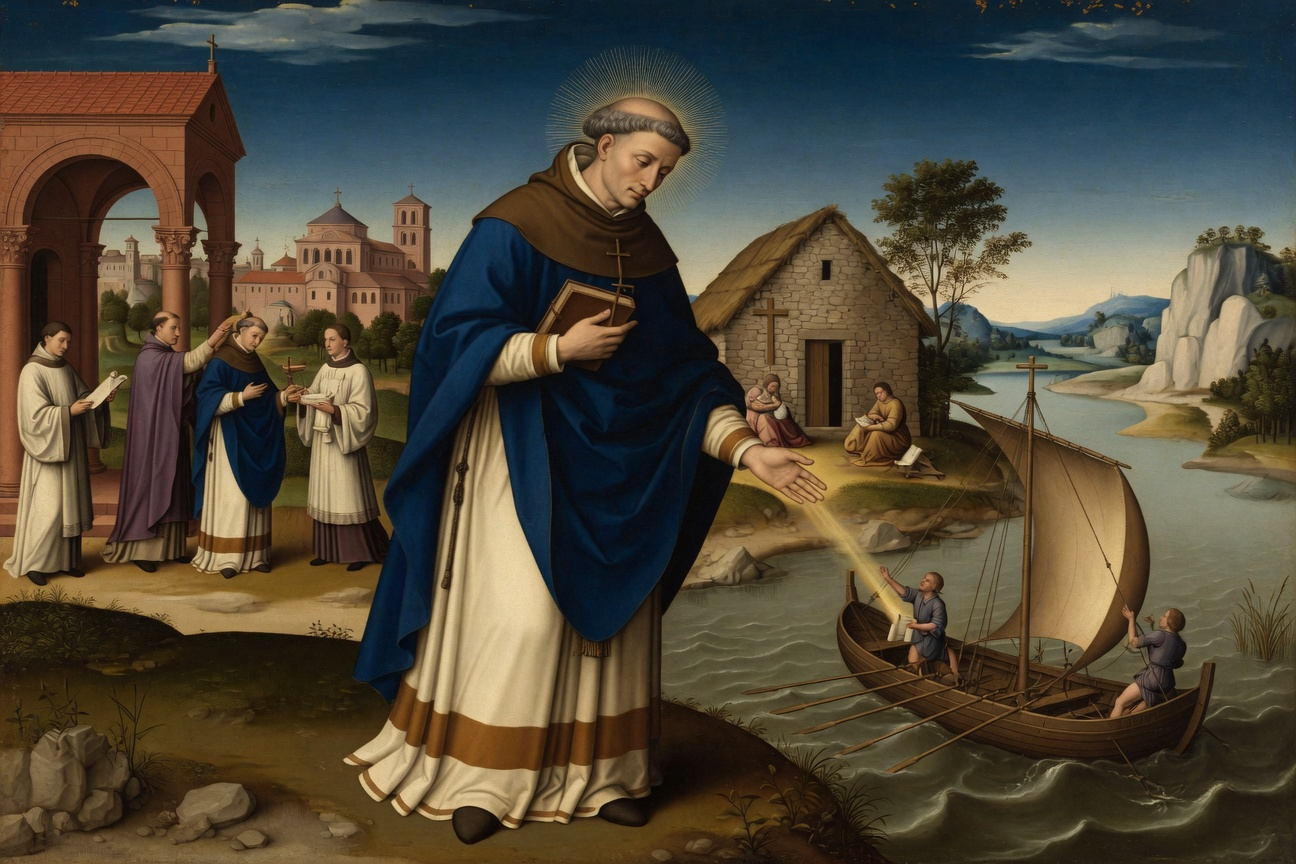
A disciple of Saint Maximin of Trier, Castor became a priest before retiring as a hermit to Cardon on the Moselle. There he led a life of prayer surrounded by disciples and miraculously saved a boat from a storm. His relics, discovered later, made him the patron saint of the city of Koblenz.
Contemporaries

Figures and markers around the normalized period for this entry.
Guided reading
6 reading sections
SAINT CASTOR, PRIEST, PATRON OF KOBLENZ (389).
Formation and priesthood
Castor received a pious education under the guidance of Saint Maximin, Bishop of Trier, before being ordained deacon and then priest.
Castor , whom his noble and pious parents entrusted to Saint Maximi n, Bishop of Trier , the second of that name, received, under the guidance of this prelate, the best education; then, as he made continuous progress in piety and purity of morals, he was first ordained deacon and then priest.
Eremitic life at Cardon
Drawn by solitude, Castor retired to the desert of Cardon where he led a group of disciples in a life of holiness.
But as he had a determined inclination for the solitary life, he retired to the d esert of Cardon to attend to God alone. And many, led by the love of solitude and piety, followed the man of God and placed themselves under his guidance. In the midst of his disciples, he led for a long time a very holy life, better known to God and to himself than to men.
The miracle of the salt on the Moselle
The saint saves from a storm a boat of salt whose crew had initially scorned him, thus manifesting his power of intercession.
He soon began, albeit against his will, to be renowned for his holiness. A boat loaded with salt, which was sailing on t he Mose lle, having come to pass not far from Cardon, where Castor dwelt, the latter asked, but in vain, that they give him a little of this salt, when all of a sudden the boat was agitated by a violent storm, so much so that the men, seeing themselves in danger of perishing with their vessel, implored the help of God and the intercession of Castor whom they had just scorned.
Immediately, the holy hermit, making the sign of the cross, delivered these uncharitable men from the peril and death that threatened them. The other miracles of the Saint have been snatched from the memory of men, as much by his modesty as by the length of time; and he gave more marks of his holiness after his death than during his life.
Invention and first translation of the relics
His relics were discovered by Archbishop Wecmado following the visions of the priest Martin and deposited in the Basilica of Saint-Paulin.
His relics, after having remained long ignored, were indicated to Saint We cmado, Archbi shop of Trier, by a priest of holy life named Martin, whom Sa int Ca stor had warned three times by a voice coming from heaven. After three days of fasting and solemn prayers, Saint Wecmado descended to Cardon with all his clergy, found the holy body, and deposited it with honor in the Basilica of Saint-Pa ulin, where it was glorif ied by several miracles.
Translation to Coblentz and posterity
Archbishop Hettus transfers a portion of the relics to Coblentz to found a church and a college of canons there.
It is for this reason that Hettus, archbishop of the same see, warned by Saint Maternus in a vision, and wishing to attract inhabitants to the city of Coblentz through divine worship, transferred there a portion of the reli cs of Saint Castor and placed them with great honor in a newly constructed church to be served by a college of canons.
Thus, our Saint, barely known before, is now honored in two famous churches, where two colleges of canons once flourished.
Iconography and sources
The saint is traditionally depicted saving a ship from shipwreck, according to the liturgical sources of Trier.
Saint Castor is depicted holding back a sinking ship.
Proper of Trier.
Iconography
Signs and attributes
Entities
Narrative network
The names, places, and concepts most present in the entry, weighted by centrality in the text.
The supernatural in their life
The miracles of Saint Castor of Koblenz
Frequently asked questions about Saint Castor of Koblenz
Who was Saint Castor of Koblenz?
A disciple of Saint Maximin of Trier, Castor became a priest before retiring as a hermit to Cardon on the Moselle. There he led a life of prayer surrounded by disciples and miraculously saved a boat from a storm. His relics, discovered later, made him the patron saint of the city of Koblenz.
What is Saint Castor of Koblenz the patron saint of?
Patronage of Saint Castor of Koblenz: Koblenz.
How is Saint Castor of Koblenz depicted in Christian art?
In iconography, Saint Castor of Koblenz is recognizable by: holding back a sinking ship.
What miracles are attributed to Saint Castor of Koblenz?
2 miracles are attributed to this saint, notably: Mastery of the elements, Protection / deliverance and Vision / apparition.
Which saints were contemporaries of Saint Castor of Koblenz?
Contemporaries include: Saint Blaise, Saint Hilary of Poitiers, Saint Basil the Great (Archbishop of Caesarea) and Saint Baudilus.
When did Saint Castor of Koblenz die?
Saint Castor of Koblenz died around 389.
Annexes & related entities
Structured data for exploration: events, miracles, quotes, places, attributes, patronages, and important entities cited in the text.
Key Events
- Education by Saint Maximin of Trier
- Ordination as deacon then priest
- Retreat in the desert of Cardon
- Leadership of a community of disciples
- Miracle of the salt boat on the Moselle
- Discovery of the relics by the priest Martin and Saint Wecmado
- Translation of a portion of the relics to Koblenz by Archbishop Hettus