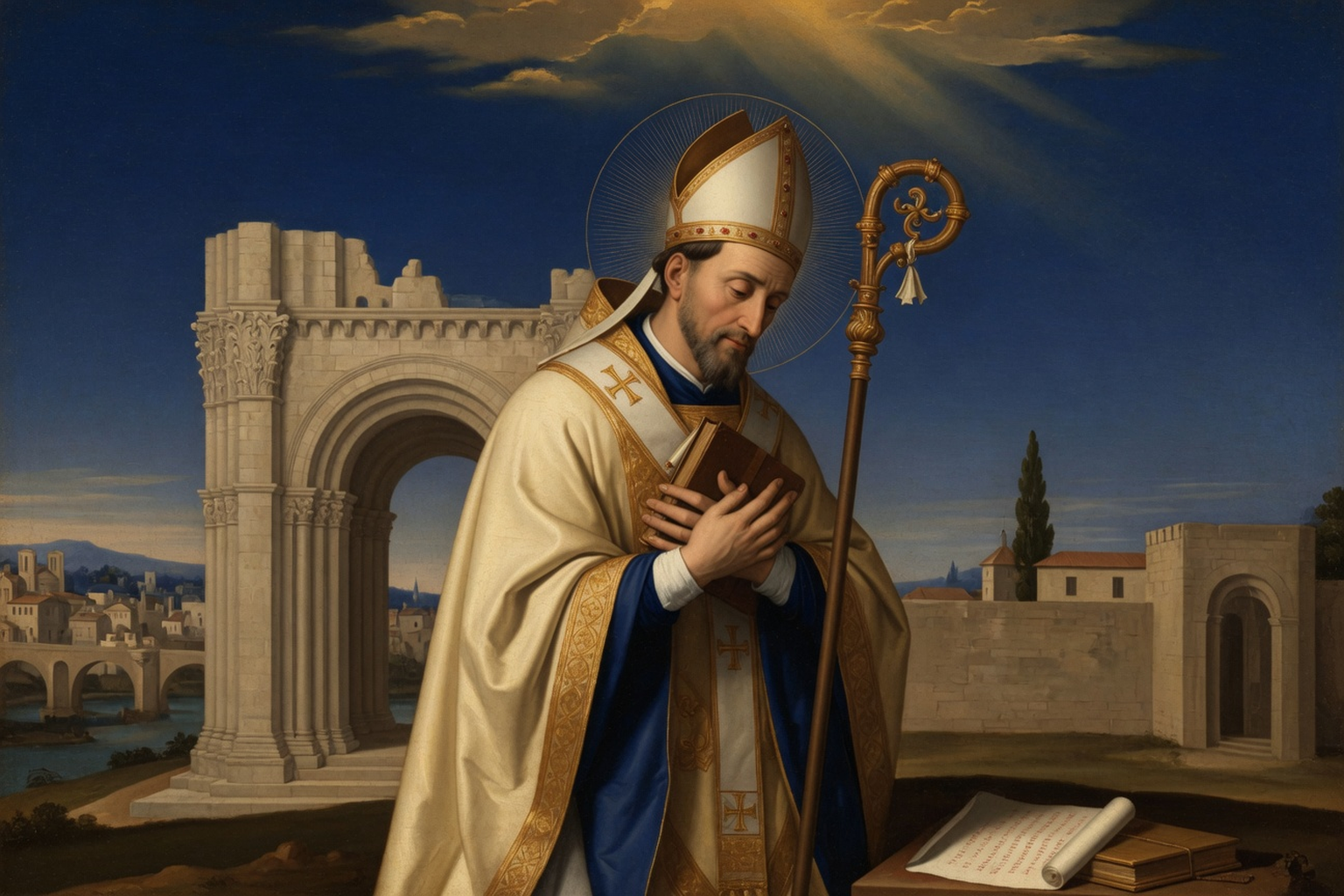
Saint Ferréol of Uzès
Bishop of Uzès in the 6th century, Ferréol succeeded his uncle Firmin. After a three-year exile in Paris due to his policy toward the Jews, he founded a monastery and wrote an innovative rule requiring the reading of the acts of the martyrs. He died in 581 after twenty-eight years of episcopate.
Contemporaries

Figures and markers around the normalized period for this entry.
Guided reading
6 reading sections
SAINT FERRÉOL, BISHOP OF UZÈS
Historical context
The narrative takes place during the pontificate of Pelagius II and the reign of the Frankish King Chilperic I.
553-581. — Pope: P elagius I I. — King of France: Chilperic I.
Origins and beginning of the episcopate
Nephew of Saint Firmin, Ferréol succeeded him as Bishop of Uzès and initially adopted a policy of conciliation towards the Jews.
Saint Firmin of Uzè s, who died in the year 553, had his nephew, Saint Ferréol, as his successor. Ferréol was t he son of Ansb ert and Blitide, famous for the part they took in the discussions among scholars regarding the genealogies of our kings. He was raised in Uzès by his paternal uncle, whom he succeeded. From the beginning of his episcopate, he applied himself to winning over the Jews through gentleness, and he even admitted them to his table. As several councils of Gaul had forbidden eating with Jews, the conduct of the holy bishop was interpreted in an unfavorable light, and, upon the complaints received by Childebert, he sent him an order t o com e to Paris. He was kept there for three whole years in a kind of exile, after which his virtue and the purity of his intentions having been recognized, he was finally permitted to return to his church. Ferréol then changed his conduct and drove from the city all the Jews who did not wish to convert.
Exile and return
Accused of violating the canons of the councils, Ferréol was exiled for three years to Paris by King Childebert before regaining his see and hardening his position.
He founded a monastery in honor of Sai nt Ferréol (martyr), w hose name he bore, and composed a rule for this community in which several things worthy of note are found. It is divided into thirty-nine chapters and addressed to Lucretius, B ishop o f Die, to wh ose judgment the author submits it.
Monastic foundation and rule
The saint founded a monastery and drafted an original rule in thirty-nine chapters, which was submitted to the Bishop of Die.
One of the articles of this rule seems to us worthy of being cited. "A collection of the acts of the martyrs and saints shall be compiled," it says, "which shall be recited in the oratory on the day of their death." This was a type of martyrology where the saints of the day were read: it is the first time we find this usage. Saint Ferréol also published a collection of his letters, in imitation of Saint Sidonius; and after having governed his church for twenty-eight years, he d ied in the si xth year of Childebert II, that is to say, in the year 581. His cult is very ancie nt in Uzès and in Lower Languedoc, where his feast is celebrated on January 4. Sain t Ferréol had a sister named Tarsicia, who deserved, through her love for virginity and her other virtues, to be numbered among the ho ly vir gins. She is honored in Rodez on January 15.
Liturgical innovation and death
Ferréol established the reading of the acts of the martyrs and published his letters before passing away in 581 after twenty-eight years of episcopate.
Taken from Hallet, September 16. — See a note on February 15.
Cult and holy kinship
His cult was established in Uzès and in Languedoc, while his sister Tarsicia is also honored as a saint in Rodez.
One of the articles of this rule seems to us worthy of being cited. "A collection of the acts of the martyrs and saints shall be drawn up," it says, "which shall be recited in the oratory on the day of their death." It was a kind of martyrology where the saints of the day were read: this is the first time we find this usage. Saint Ferréol also published a collection of his letters, in imitation of Saint Sidonius; and after having governed his church for twenty-eight years, he died in the sixth year of Childebert II, that is to say, the year 581. His cult is very ancient in Uzès and in Lower Languedoc where his feast is celebrated on January 4. Saint Ferréol had a sister named Tarsicia, who deserved, by her love for virginity and by her other virtues, to be numbered among the holy virgins. She is honored in Rodez on January 15.
Taken from Hallet, September 16. — See a note on February 15.
Entities
Narrative network
The names, places, and concepts most present in the entry, weighted by centrality in the text.
Frequently asked questions about Saint Ferréol of Uzès
Who was Saint Ferréol of Uzès?
Bishop of Uzès in the 6th century, Ferréol succeeded his uncle Firmin. After a three-year exile in Paris due to his policy toward the Jews, he founded a monastery and wrote an innovative rule requiring the reading of the acts of the martyrs. He died in 581 after twenty-eight years of episcopate.
What is Saint Ferréol of Uzès the patron saint of?
Patronage of Saint Ferréol of Uzès: Uzès.
How did Saint Ferréol of Uzès die?
Saint Ferréol of Uzès suffered martyrdom for the Christian faith (6th century).
Which saints were contemporaries of Saint Ferréol of Uzès?
Contemporaries include: Saint Remigius (Apostle of the Franks), Saint Antide of Besançon, Saint Eugene of Carthage and Saint Nicaise of Reims.
Who are the relatives of Saint Ferréol of Uzès?
Relatives of Saint Ferréol of Uzès: Ansbert (father), Blitide (mother), Saint Firmin d'Uzès (paternal uncle) and Sainte Tarsicie (sister).
Annexes & related entities
Structured data for exploration: events, miracles, quotes, places, attributes, patronages, and important entities cited in the text.
Key Events
- Succeeded his uncle Saint Firmin in 553
- Attempt to convert the Jews through gentleness
- Three-year exile in Paris by order of Childebert
- Return to Uzès and expulsion of non-converted Jews
- Foundation of a monastery and drafting of a monastic rule
- Publication of a collection of letters
Quotes
-
A collection of the acts of the martyrs and saints shall be compiled, to be recited in the oratory on the day of their death
Rule of Saint Ferréol