Saint Simeon of Metz
Originally from Crete and of Israelite lineage, Saint Simeon was Bishop of Metz for thirty years. His relics were transferred to the Abbey of Senones by Bishop Angelram under the reign of Charlemagne. Recognized as one of the greatest thaumaturges of the Vosges, he is celebrated on February 17 and his translation on October 25.
Guided reading
4 reading sections
SAINT SIMEON, BISHOP OF METZ (194).
Origins and Episcopate
Saint Simeon, of Cretan origin and Jewish lineage, served as Bishop of Metz for thirty years.
Saint Simeon was a native of the island of Cret e; the blood of Israel flowed in his veins: he held the see for thirty years: this is all that is known of him. This holy bishop, honored in the ancient l iturgy of the d iocese of Metz, having been omitted from the new Proper by a most regrettable oversight, we shall insert the following note, due to M. Noël, parish priest of Drie y, which will expla in how the abbey of Senones, so illustrated by Dom Calmet, came to be in possession of such a rich treasure.
Translation of the relics to Senones
Bishop Angelramus transfers the body of Saint Simeon to the abbey of Senones to appease tensions with the religious.
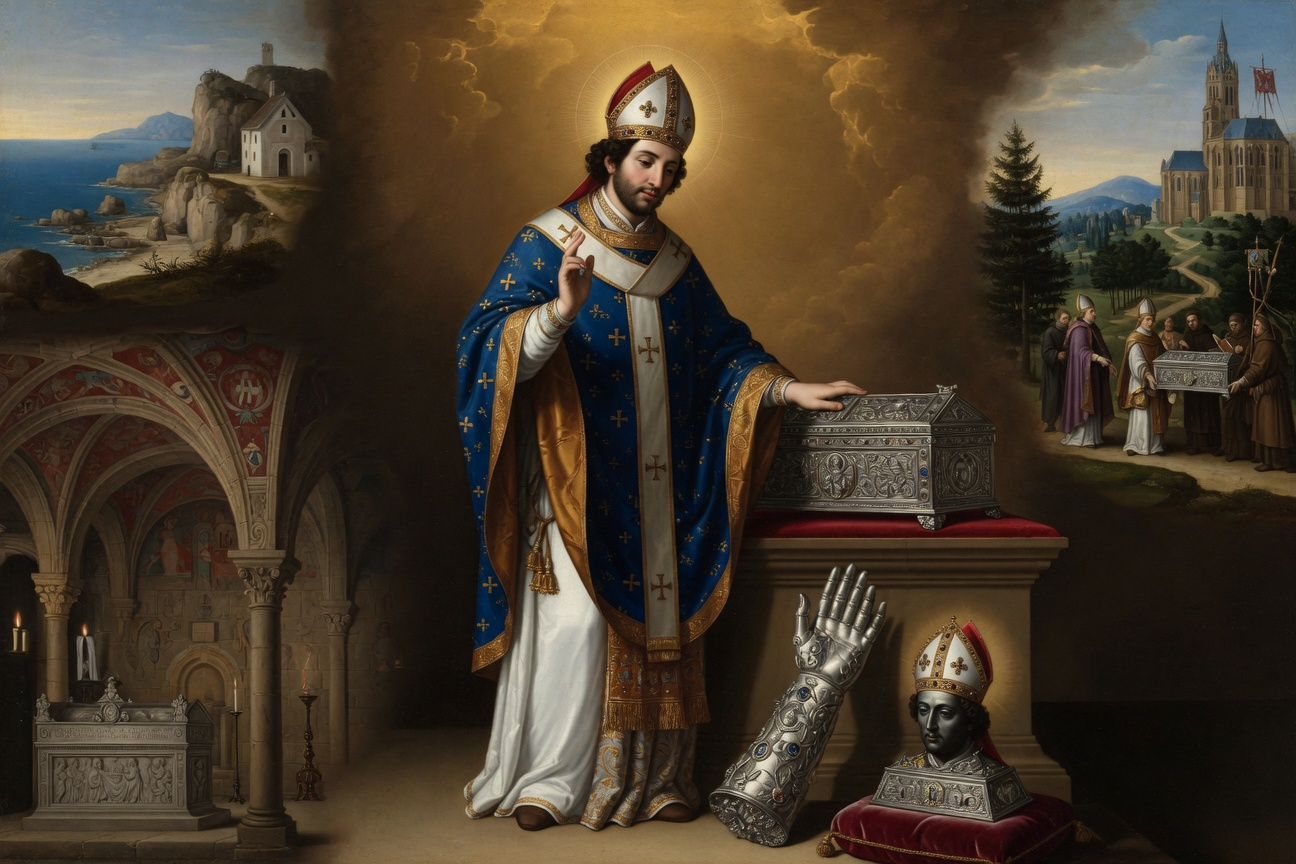
Saint Simeon, Bishop of Metz , was buried, like most of his predecessors, in the crypt of Saint-Clement. Angelramus, one of hi s successors to the see of Metz, having subjected the abbey of Senones, of which he was abbot, to his church, its religious, hitherto exempt from episcopal jurisdiction, murmured against it. The bishop, all-powerful at the court of Charlema gne, of whom he was archchaplain, wishing however to regain the affection of his religious through his benevolence, presented them with the body of Saint Simeon, already renowned for his miracles. But the monks of Senones, dissatisfied with the conduct of Angelramus, refused to receive the relics of the Saint into their church. The Bishop of Metz deposited them in a chapel he had built on a hill overlooking the monastery to the south, which could still be seen in the last century. God manifested His power and the merits of the Saint there through daily miracl es, says the monk Richer, an ancient chronicler of Senones, which finally led the religious to solemnly transport the body of Saint Simeon into their church, dedicated to Saint Peter and Saint Paul, where it remained until the destruction of the abbey, in a silver shrine. The head and an arm were kept separately in silver reliquaries shaped accordingly. Every year, on October 25, a commemoration of this translation was held at Senones. One must read in the chronicle of Richer, a religious of Senones who lived in the 13th century, the summary of the numerous miracles performed at the tomb of Saint Simeon, which have made him one of the greatest wonder -workers of the Vosges.
Miracles and local veneration
Recognized as a great wonder-worker of the Vosges, his relics performed numerous miracles reported by the chronicler Richer.
Chron. Richer, lib. II, and 1, 2, 4.
Historical sources
The information is based primarily on the chronicle of Richer, a monk of Senones in the 13th century.
Chron. Richer, lib. II, et 1, 2, 4.
Iconography
Signs and attributes

Entities
Narrative network
The names, places, and concepts most present in the entry, weighted by centrality in the text.
The supernatural in their life
The miracles of Saint Simeon of Metz
Frequently asked questions about Saint Simeon of Metz
Who was Saint Simeon of Metz?
Originally from Crete and of Israelite lineage, Saint Simeon was Bishop of Metz for thirty years. His relics were transferred to the Abbey of Senones by Bishop Angelram under the reign of Charlemagne. Recognized as one of the greatest thaumaturges of the Vosges, he is celebrated on February 17 and his translation on October 25.
What is Saint Simeon of Metz the patron saint of?
Patronage of Saint Simeon of Metz: Senones Abbey.
How is Saint Simeon of Metz depicted in Christian art?
In iconography, Saint Simeon of Metz is recognizable by: Silver reliquary and Silver reliquaries (head and arm).
What miracles are attributed to Saint Simeon of Metz?
1 miracle are attributed to this saint, notably: Sign / wonder.
Annexes & related entities
Structured data for exploration: events, miracles, quotes, places, attributes, patronages, and important entities cited in the text.
Key Events
- Thirty-year episcopate in Metz
- Initial burial in the crypt of Saint-Clément
- Translation of his relics to Senones by Bishop Angelram
- Initial refusal by the monks of Senones to receive the relics
- Temporary burial in a chapel on a hill overlooking the monastery
- Solemn translation to the church of Saint-Pierre and Saint-Paul in Senones following numerous miracles