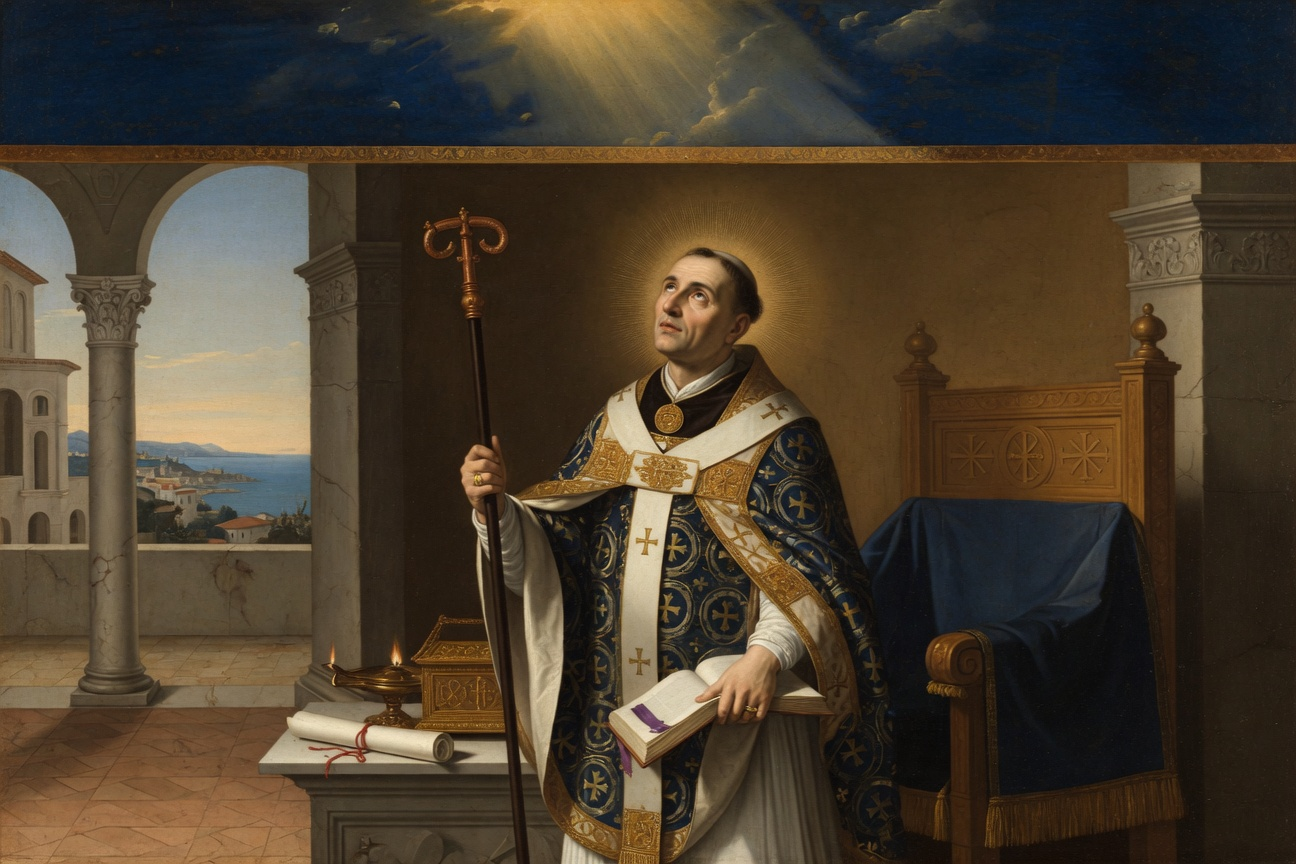
Saint Armentarius of Antibes
Bishop of Antibes in the mid-5th century, Armentarius participated in the ecclesiastical affairs of his time alongside Pope Saint Leo. His cult, very ancient in Grasse, is particularly vibrant in Draguignan, of which he is the patron. His relics are venerated there in a former Benedictine priory.
Contemporaries

Figures and markers around the normalized period for this entry.
Guided reading
4 reading sections
SAINT ARMENTARIUS, BISHOP OF ANTIBES (5th century).
Episcopate and ecclesial context
Armentarius governed the church of Antibes in the middle of the 5th century and participated in the diplomatic exchanges between Pope Leo and the bishop of Arles.
Armentariu s, also named Armatarius and Hermentarius, governed the chur ch of A ntibes around the middle of the 5th century. It is believed that he was one of the nineteen bishops who sent, by deputation, a p etition to Pope Saint Leo to obtain the restitution of the rights of the c hurch of Arles, and to whom this Pope replied by sending to Ravenius, bishop of Arles, his letter to Flavian, and requesting that he confess the common faith by his own suffrage and by that of the neighboring bishops.
Transfer of the See and Cult in Grasse
The memory of the saint is honored in Grasse, the city that became the episcopal see of Antibes from the 13th century onwards.
The memory of Saint Armentarius enjoys a very ancient cult in the church of Gr asse, where the episcopal see of Antibes was transferred in the 13th century.
Patronage and veneration in Draguignan
Saint Armentaire is the patron saint of Draguignan, where his relics are venerated in an ancient Benedictine priory.
The city of Draguignan , in the diocese of Fr éjus, honors him as its patron; within the territory of this city, one notes a church decorated for several centuries with the title of priory of the Order of Saint Be nedict: the neighboring peoples go there in devotion to venerate the relics of the Saint and to implore his protection from God, a protection whose effectiveness they have experienced more than once.
Liturgical sources
The information comes from the Proper of the Diocese of Fréjus.
*Proper of Fréjus.*
Entities
Narrative network
The names, places, and concepts most present in the entry, weighted by centrality in the text.
Frequently asked questions about Saint Armentarius of Antibes
Who was Saint Armentarius of Antibes?
Bishop of Antibes in the mid-5th century, Armentarius participated in the ecclesiastical affairs of his time alongside Pope Saint Leo. His cult, very ancient in Grasse, is particularly vibrant in Draguignan, of which he is the patron. His relics are venerated there in a former Benedictine priory.
What is Saint Armentarius of Antibes the patron saint of?
Patronage of Saint Armentarius of Antibes: Draguignan.
What is Saint Armentarius of Antibes invoked for?
Saint Armentarius of Antibes is invoked for: divine protection.
Which saints were contemporaries of Saint Armentarius of Antibes?
Contemporaries include: Saint Augustine of Hippo, Saint Honoratus of Arles, Saint James of Tarentaise and Saint Jerome of Stridon.
When did Saint Armentarius of Antibes die?
Saint Armentarius of Antibes died around 500.
What are the other names of Saint Armentarius of Antibes?
Other forms of the name: Armataire and Hermentaire.
Annexes & related entities
Structured data for exploration: events, miracles, quotes, places, attributes, patronages, and important entities cited in the text.
Key Events
- Governed the church of Antibes around the middle of the 5th century
- Presumed participation in a deputation of nineteen bishops to Pope Saint Leo
- Petition for the restitution of the rights of the Church of Arles