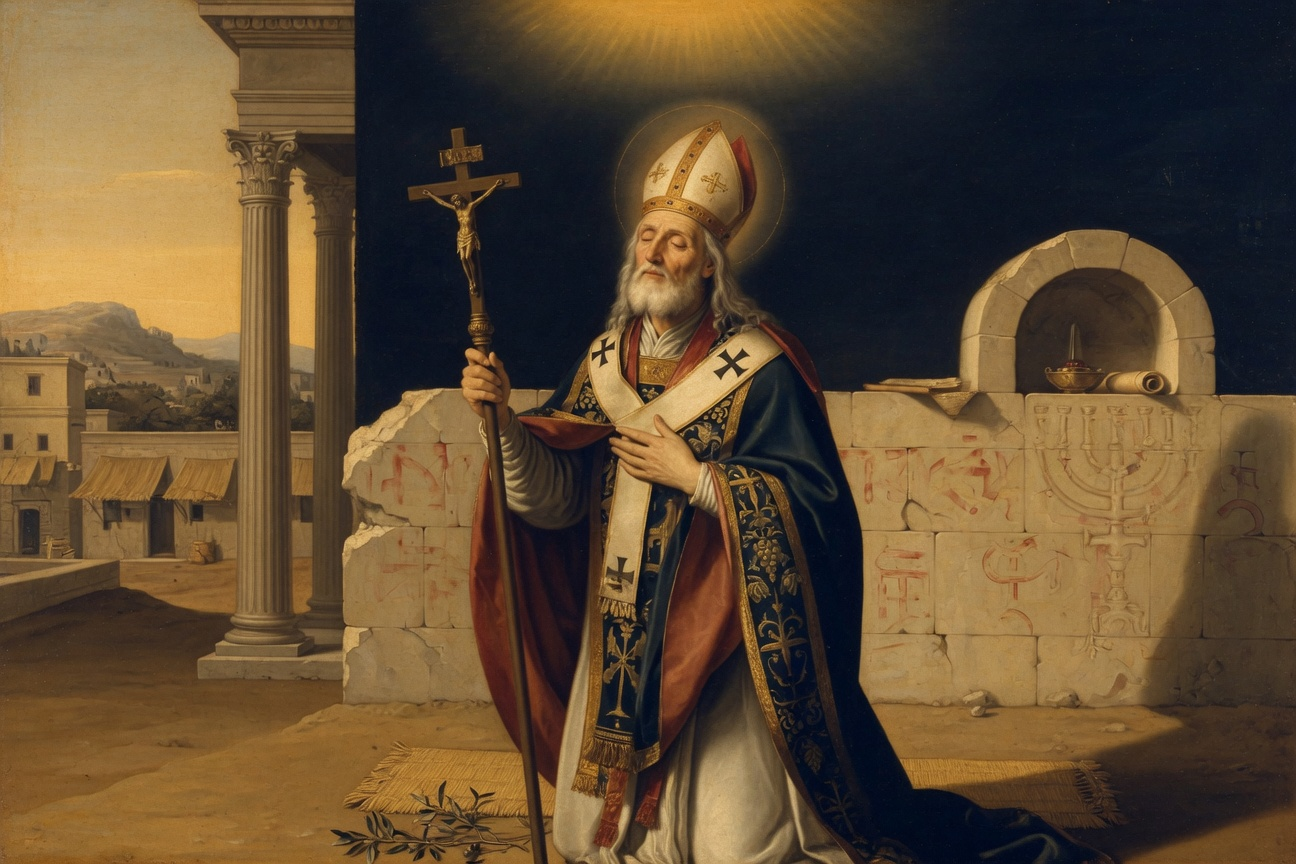
Saint Simeon of Jerusalem
Cousin of Jesus and successor to Saint James as Bishop of Jerusalem, Saint Simeon led the Christian community to Pella during the destruction of the Holy City. As the last surviving eyewitness of Christ, he was crucified at the age of 120 under Emperor Trajan after enduring cruel torments.
Contemporaries

Figures and markers around the normalized period for this entry.
Guided reading
6 reading sections
SAINT SIMEON, BISHOP OF JERUSALEM AND MARTYR
Origins and Kinship
Simeon, son of Cleophas and Mary, is presented as a close relative of Jesus and the apostles, having followed Christ from a very young age.
The most venerable of all old ages is not that which counts the most years; but that which, to its white hair, joins the honor of a life without reproach and without weakness; for, the Lord also says, there are three things that I hate above all: a proud poor man, a vain rich man, and a foolish and senseless old man.
Wis., IV, 8; Eccl., XXV, 4.
Saint Simeon had for his father Cleophas, otherwise known as Alphaeus, brother of Saint Joseph, and for his mother, Mary, who had the happiness of accompanying the most holy Virgin to Calvary. The most skilled interpreters believe that he is the same as that Simon, brother of Saint James the Less, of Saint Jude, and of Joseph, who is spoken of in the Gospel. He was born eight or nine years before the Savior; and one cannot doubt that he set out early in his following with his father, his mother, and his three brothers. It seems no less certain that he received the Holy Spirit on the day of Pentecost with the Blessed Virgin and the Apostles, and that he was among the number of those who are designated under the general title of brothers of the Lord.
Election to the See of Jerusalem
After the martyrdom of Saint James the Less in 62, Simeon was unanimously elected to succeed him as Bishop of Jerusalem.
When the Jews had massacred, in 62, Saint James the Less, the fir st bishop of Jerusal em, Saint Simeon had the courage to reproach them for this horrible cruelty. He was not unaware of the danger to which he was exposing himself; but he was animated by that spirit of strength which makes one superior to any feeling of fear. Some time later, the Apostles and disciples, having assembled in Jerusalem to give a successor to Saint James, elected Simeon with one voice. It is believed that he had previously assisted his brother in the government of his church.
The exile to Pella and the ruin of Jerusalem
Warned by God, the Christians and their bishop fled Jerusalem for Pella in 66, before the destruction of the city by the Romans.
The Romans, weary of the continual revolts of the Jews, finally resolved to destroy Je rusalem; they therefore set out to execute their design: but God, who wished to save his servants, warned them miraculously to leave a city upon which he was about to unleash his vengeance in the most formidable manner. The Christians, docile to the voice of heaven, departed with their bishop and withdrew to the small town of Pella, situated beyond the Jo rdan. This happened in the year 66 of Jesus Christ and before Vespasian had formed the siege of Jerusalem. The faithful crossed back over the Jordan after the ruin of this unfortunate city and came to dwell in the midst of its debris. The Church was soon seen to flourish there again.
God visibly declared himself its protector, and he glorified it with so many wonders that a great number of Jews embraced Christianity. Things remained in this state until the final years of Hadrian, who had Jerusalem entirely razed.
Defense of the faith against heresies
During his long episcopate, Simeon contained the influence of the Nazarene and Ebionite sects, which denied the divinity of Christ.
The joy that Saint Simeon felt in seeing the disciples of Jesus Christ multiply every day was troubled by the birth of two heresies: that of the Nazarenes an d that of the Ebionites . The Naz arenes approached both Jews and Christians on several points, although at heart they detested both. In truth, they regarded Jesus Christ as the greatest of the Prophets; but at the same time, they denied that He was God. They observed both the Sabbath and Sunday, and created a monstrous alloy of the ceremonies of the Old and New Law. To all these errors, the Ebionites added others that were peculiar to them: they taught, for example, that divorce was lawful and that one could indulge in infamous crimes without scruple. The author of this latter sect first dogmatized in the village of Cocabe, beyond the Jordan; he later moved to Asia, and came as far as Rome. The heretics, until then timid, did not dare to spread their errors in public during the episcopate of Saint Simeon, who lived longer than any of the Lord's disciples. But no sooner had God withdrawn him from this world than one saw a frightful multitude of impious doctrines emerge from hell, which openly attacked the purity of the faith.
Arrest and martyrdom
Denounced as a Christian and a descendant of David, Simeon was tortured and then crucified at the age of 120 under the Emperor Trajan.
Providence had allowed our Saint to escape the searches that Vespasian and Domitian had made for all those who were of the race of David: but Trajan, for a de testab le reason of State, persecuted not only the Christians as enemies of his gods, but also all the Jews who descended from the race of David, because he had heard it said that a prince was to be born in this royal family, who would deliver his people from servitude and make himself formidable to the whole earth.
Simeon, aged one hundred and twenty years, was therefore accused and brought before the tribunal of Atticus, a consular personage and lieutenant of the emperor. The accusation was based on two counts: one was his religion, the other his birth. Atticus entered into a conference with Simeon, to persuade him to renounce the faith of Jesus Christ and to obey Caesar; but, seeing that he was working in vain, he had him whipped several times, and exposed him to other cruel torments, which the holy old man suffered with such courage and with such resolution, that the judge and the assistants were surprised to see a body worn by the years resist such atrocious pains. But God, who had given to such a great number of innocent virgins and to little children the strength to endure the rigor of the elements and to despise the pains that the rage of the barbarians invented every day to persecute them; God gave to this venerable old man the courage to suffer constantly and to die finally on a cross like the Savior. His death occurred on February 18, the year of Our Lord 107 or 109, under the empire of Trajan.
It is with h is death that the so-called apostolic times end, that is to say that Saint Simeon is considered the last survivor of those who had had the happiness of seeing Jesus Christ on earth.
God permitted that the denouncers of the disciple of His Son should fall themselves into the nets they had set for him. The Roman judges found or feigned to find that they were also of the royal race: they paid with their heads for the crime of their birth, but without having the consolation of dying for Jesus Christ, like Saint Simeon.
Cult and posterity
Considered the last eyewitness of Christ, his memory is honored in the East and the West, and several cities claim his relics.
The Greeks honor his memory on April 27, and the Latins on February 18. Some Western churches, those of Brindisi and Bologna in Italy, that of Brussels in Belgium, and that of Torrelaguna near Madrid, are said to possess some of his relics. Blodphere Calixte wrote of his martyrdom, and the Roman Martyrology, along with others, commemorates him.
Iconography
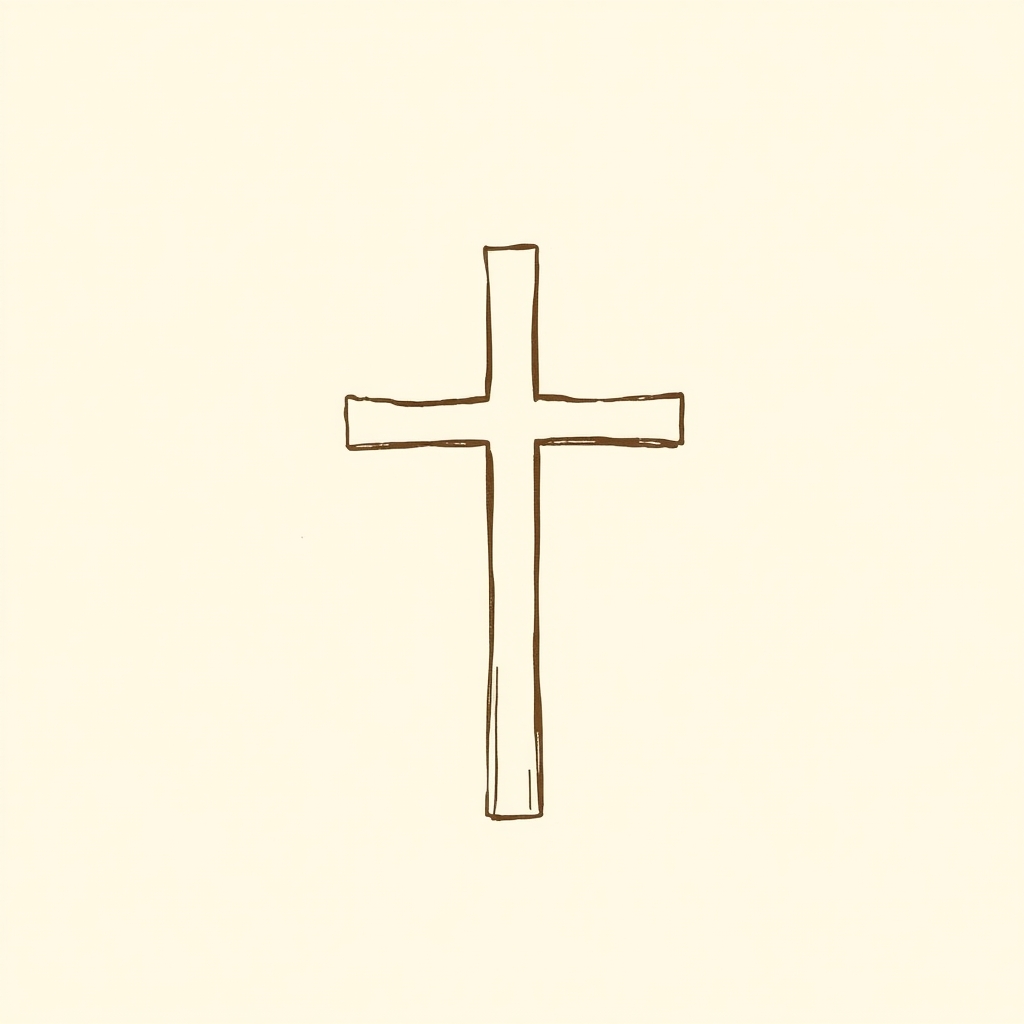
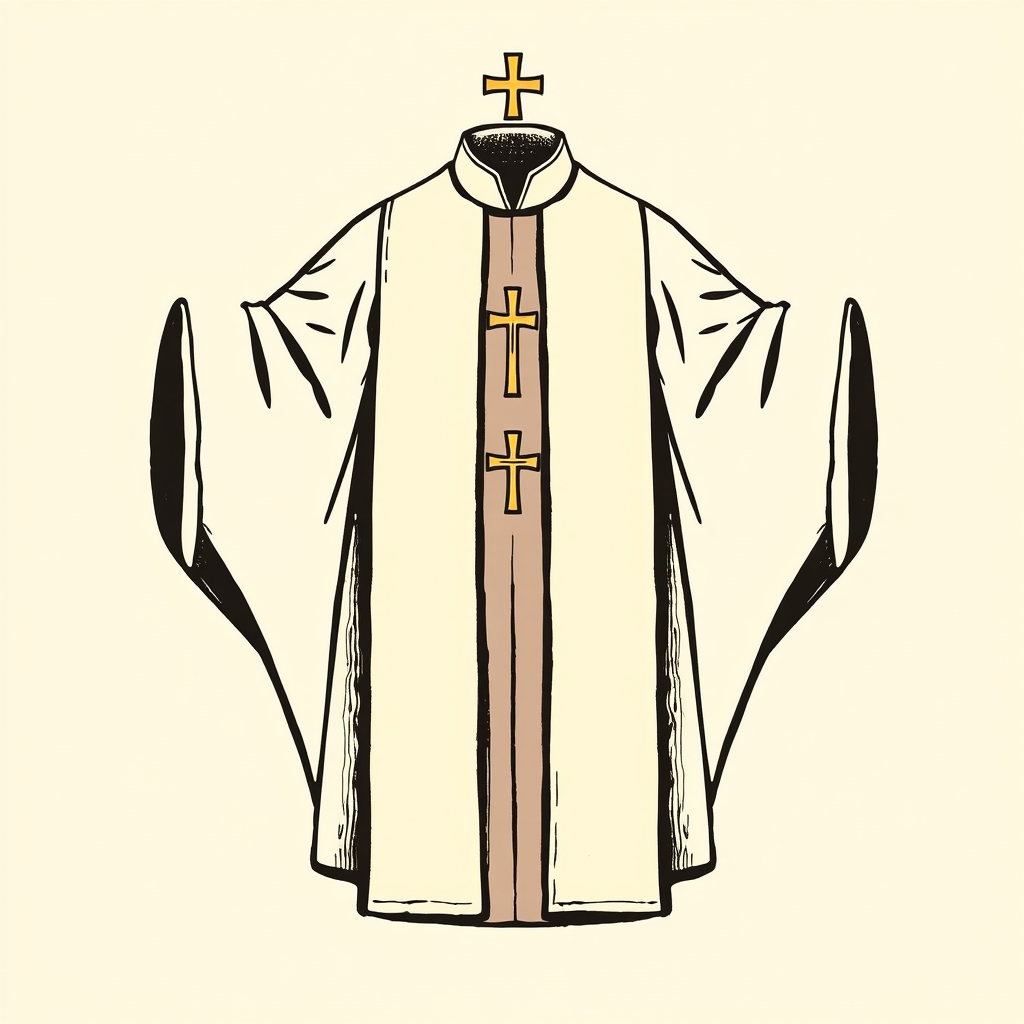
Signs and attributes

Entities
Narrative network
The names, places, and concepts most present in the entry, weighted by centrality in the text.
The supernatural in their life
The miracles of Saint Simeon of Jerusalem
Frequently asked questions about Saint Simeon of Jerusalem
Who was Saint Simeon of Jerusalem?
Cousin of Jesus and successor to Saint James as Bishop of Jerusalem, Saint Simeon led the Christian community to Pella during the destruction of the Holy City. As the last surviving eyewitness of Christ, he was crucified at the age of 120 under Emperor Trajan after enduring cruel torments.
How is Saint Simeon of Jerusalem depicted in Christian art?
In iconography, Saint Simeon of Jerusalem is recognizable by: cross, episcopal vestments and white hair.
How did Saint Simeon of Jerusalem die?
Saint Simeon of Jerusalem suffered martyrdom for the Christian faith (2nd century).
What miracles are attributed to Saint Simeon of Jerusalem?
1 miracle are attributed to this saint, notably: Prophecy / infused knowledge and Protection / deliverance.
Which saints were contemporaries of Saint Simeon of Jerusalem?
Contemporaries include: Saint Dionysius the Areopagite (First Bishop of Paris), Saint Pothinus and his companions (Martyrs of Lyon), Saint Benignus of Smyrna and Jesus Christ (Relics of the Passion).
What are the other names of Saint Simeon of Jerusalem?
Other forms of the name: Simon.
Who are the relatives of Saint Simeon of Jerusalem?
Relatives of Saint Simeon of Jerusalem: Cléophas (Alphée) (father), Marie (mother), Saint Joseph (uncle), Saint Jacques le Mineur (brother), Saint Jude (brother) and Joseph (brother).
Annexes & related entities
Structured data for exploration: events, miracles, quotes, places, attributes, patronages, and important entities cited in the text.
Key Events
- Born approximately 8 or 9 years before Jesus Christ
- Reception of the Holy Spirit on the day of Pentecost
- Election as second bishop of Jerusalem in the year 62
- Retreat to Pella in the year 66 before the siege of Jerusalem
- Return to Jerusalem after its destruction
- Struggle against the heresies of the Nazarenes and Ebionites
- Arrested under Trajan as a Christian and descendant of David
- Martyrdom by crucifixion at the age of 120
Quotes
-
The most venerable of all old ages is not that which counts the most years; but that which, to its white hair, joins the honor of a life without reproach.
Introduction of the text (inspired by Wis. 4:8)