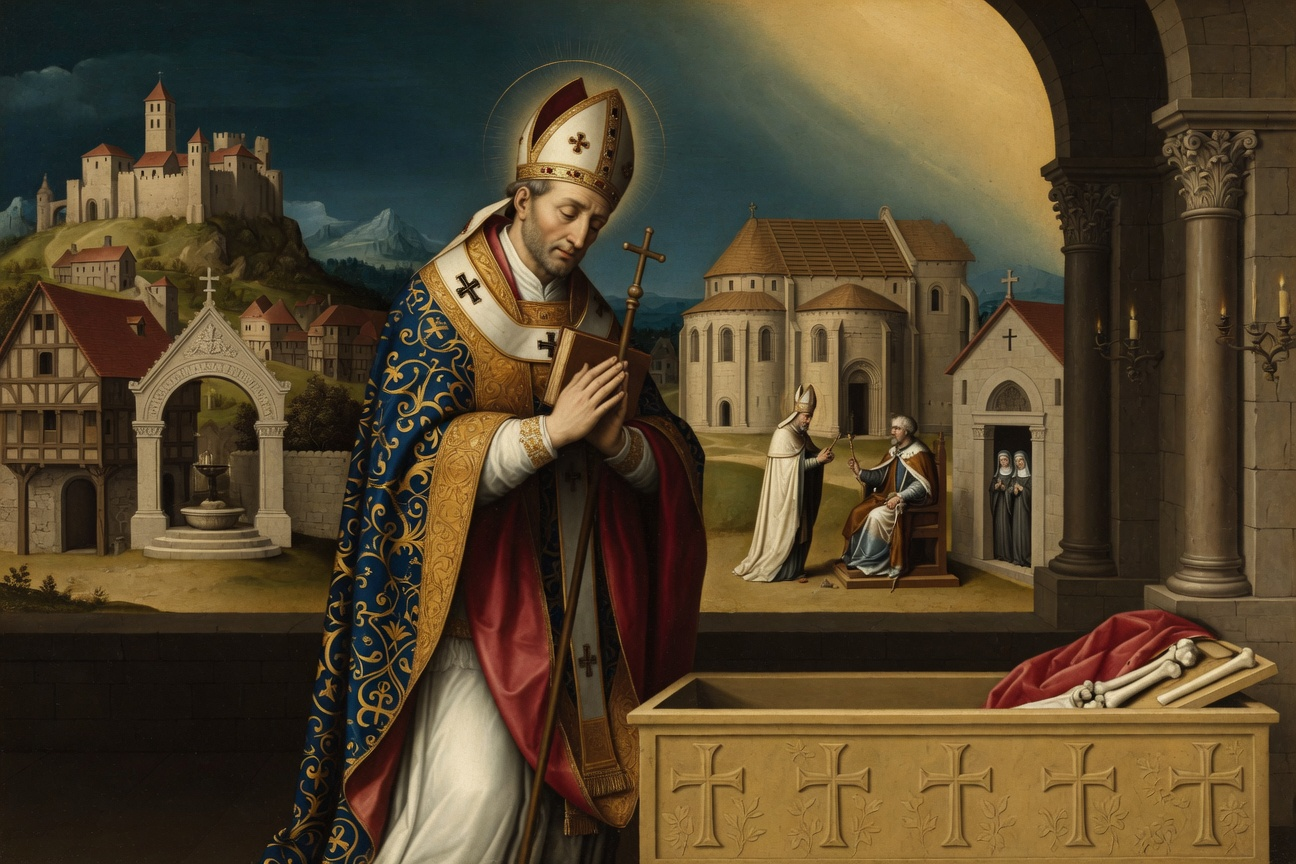
A former governor under King Guntram, Arigle became Bishop of Nevers in the 6th century. Known for his eloquence and piety, he founded the first monastery for women in the diocese. His relics, partially preserved after the Revolution, are still invoked in Nevers, particularly during cholera epidemics.
Contemporaries

Figures and markers around the normalized period for this entry.
Guided reading
7 reading sections
SAINT ARIGLE OR ARILLE (AGRICOLE), BISHOP OF NEVERS (594).
Origins and civil career
Born in Sainte-Reine and a friend of the poet Fortunatus, Arigius was first a governor under King Guntram before being chosen as bishop of Nevers.
He was born in Sainte-Reine, of distinguished parents, and was a friend of the poet Fortunatus. Guntram, King of Burgundy, had appointed him governor of the region; but upon the death of Saint Eoladius, his reputation for holiness led to his selection to ascen d the episcopal see of Nevers.
The mastery of speech
The saint is recognized for his great verbal prudence, illustrating the precept of Saint James on perfection through the tongue.
It was especially noted in him the care with which he watched over his words: Now, sa ys Saint Jame s, he who does not sin with his tongue is perfect.
Episcopacy and monastic works
After thirteen years of episcopacy, he died in 594, leaving behind him the first monastery for women in the diocese of Nevers.
After having borne the episcopal burden with devotion for thirteen years, he fell asleep in the Lord on February 26, 594. His body was laid to rest in th e church of Saint-Vince nt, which he had founded, and where he established a monastery for girls, the first known in the diocese of Nevers. The church of Saint-Vincent bore the name of Saint-Arigle in the 9th century, and was erected as a parish at the end of the 11th century (1075).
Translation and survival of the relics
His relics, moved in 1398, partially survived the French Revolution and are today kept at the church of Saint-Étienne.
In 1398, his bones were removed from his tomb and placed in a reliquary. The revolutionary turmoil saw the demolition of the church of Saint-Arigle and the dispersal of his relics.
It was, however, fortunate that a considerable portion was preserved, which is found today at the church of Saint-Étienne in Neve rs. — The inhabitants of this city still have recourse today to the powerful intercession of their holy bishop.
Protection against epidemics
In the 19th century, the saint's reliquary was displayed to protect the city of Nevers against cholera epidemics.
When in 1832 and 1848, cholera was wreaking cruel havoc in Nevers, the reliquary of Saint Arigle w as brought d own and exposed to the veneration of the faithful.
Symbolism of funerary crosses
Explanation of the symbolism of the seven crosses on Arigle's tomb, representing the fullness of the episcopal priesthood and the sacraments.
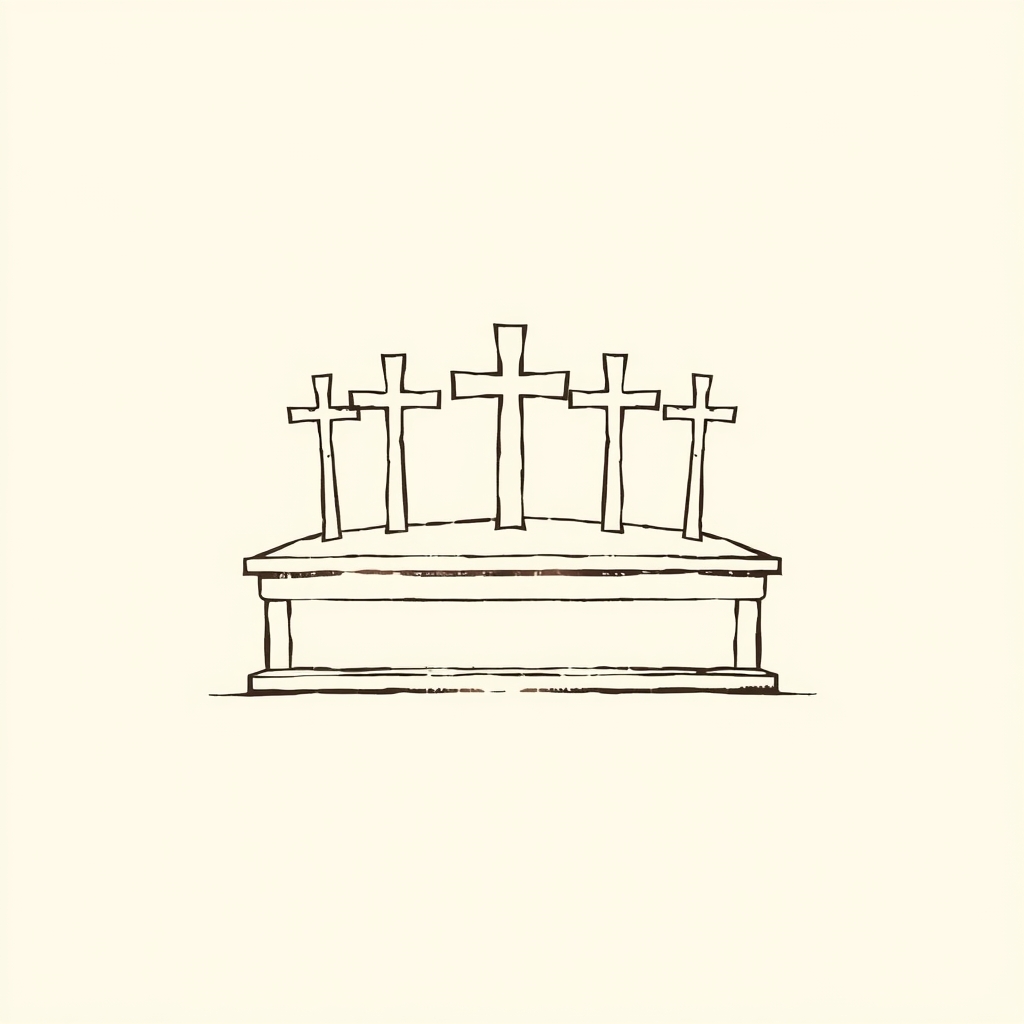
Significance of the seven crosses, the three crosses, and a single cross on Christian sarcophagi. — The tomb of Saint Arigle was adorned with seven crosses in relief. Why this number? Let us recall above all that the sacraments draw their value and virtue from the Savior's cross. As the bishop possesses the fullness of the priesthood, to him belongs the power to administer all the sacraments. This is what the number seven, placed on the tomb of bishops, was intended to indicate. The power of the priest is less extensive, and as he is the ordinary minister of five sacraments, coffins adorned with five crosses were reserved for priests. Finally, on the tomb of a simple believer, only one cross was placed to indicate the presence of a disciple of Jesus Christ, or three crosses to recall that it is in the name of the three persons of the Trinity and by the virtue of the Cross that he was admitted into the number of the children of God.
Hagiographic source
The text is taken from the Hagiology of Nevers written by Monsignor Crounier.
Mgr Crounier , Hagiology of Nevers.
Iconography
Signs and attributes
Entities
Narrative network
The names, places, and concepts most present in the entry, weighted by centrality in the text.
The supernatural in their life
The miracles of Saint Arigius (Arille, Agricola)
Frequently asked questions about Saint Arigius (Arille, Agricola)
Who was Saint Arigius (Arille, Agricola)?
A former governor under King Guntram, Arigle became Bishop of Nevers in the 6th century. Known for his eloquence and piety, he founded the first monastery for women in the diocese. His relics, partially preserved after the Revolution, are still invoked in Nevers, particularly during cholera epidemics.
What is Saint Arigius (Arille, Agricola) the patron saint of?
Patronage of Saint Arigius (Arille, Agricola): Nevers.
What is Saint Arigius (Arille, Agricola) invoked for?
Saint Arigius (Arille, Agricola) is invoked for: cholera.
How is Saint Arigius (Arille, Agricola) depicted in Christian art?
In iconography, Saint Arigius (Arille, Agricola) is recognizable by: seven crosses on the sarcophagus.
What miracles are attributed to Saint Arigius (Arille, Agricola)?
1 miracle are attributed to this saint, notably: Protection / deliverance.
Which saints were contemporaries of Saint Arigius (Arille, Agricola)?
Contemporaries include: Saint Remigius (Apostle of the Franks), Saint Antide of Besançon, Saint Eugene of Carthage and Saint Nicaise of Reims.
When did Saint Arigius (Arille, Agricola) die?
Saint Arigius (Arille, Agricola) died around 600.
What are the other names of Saint Arigius (Arille, Agricola)?
Other forms of the name: Arille and Agricole.
Annexes & related entities
Structured data for exploration: events, miracles, quotes, places, attributes, patronages, and important entities cited in the text.
Key Events
- Born in Sainte-Reine
- Governor of the region under King Guntram
- Election to the episcopal see of Nevers after Saint Eolade
- Thirteen-year episcopate
- Foundation of the Church of Saint-Vincent and a convent for women
- Died in 594
Quotes
-
He who does not sin with his tongue is perfect.
Saint James (cited in the text)