Saint Stapin of Dourgne
Originally from Dourgne, Saint Stapin first led the life of a hermit before being elected Bishop of Carcassonne between the 7th and 8th centuries. Honored for his holiness in France, Italy, and Germany, he is particularly invoked for the healing of leg ailments. His cult remains active in Dourgne, where a church has been dedicated to him since the 17th century.
Contemporaries

Figures and markers around the normalized period for this entry.
Guided reading
6 reading sections
SAINT STAPIN OF DOURGNE, CONFESSOR,
Historical sources and origins
Presentation of 17th-century historical sources attesting to the existence of Saint Stapin, a native of Dourgne and Bishop of Carcassonne.
Gérard de Vic, in his History of the Bishops and Memorable Events of the Church of Carcassonne (1666), adds a supplement devoted to the bishops of that same see whose lives do not bear a precise date, asserting that this supplement is extracted from an ancient series of these same bishops, described in 1552, from an even older martyrology used by the Church of Carcassonne during the lifetime of this biographer. "In this series," the text says, "appears Saint S tapin, a nat ive of Dourgne, diocese of Lavaur, honored for a very long time as a saint in his native land, as well as in Ventenne , dioces e of Carcassonne, and in that very city, at the cemetery of Saint-Vinant. We still see there today a chapel that attracts a large influx of people eager to attend the holy offices and to venerate the relics of this pontiff, on August 6, the day his memory is celebrated. This Saint is also honored, under the title of Bishop of Carcassonne, in some regions of Germania." It is likely in this martyrology that Mgr de Besnot, Bishop of Carcassonne, found the name of Saint Stapin, since he inserted this holy bishop among his predecessors in the ritual he issued in 1764.
European expansion of the cult
The saint's cult extends from Italy (Milan) to France (Lyon, Dourgne) with the papal recognition of Alexander VII.
Joseph Sementius, a religious of Milan, states in his Biography of Saint Stapin, reported by the Bollandists, that Saint Stapin has an altar in Milan, in the church of Saint Mary, surrounded by the Reverend Somascan Fathers, and that his feast is celebrated there every year with solemn pomp, as well as in several other places in Italy; that, by a brief given in Rome in 16 71, Pope Alexander VII granted numerous indulgences to a Confraternity of men and women under the patronage of Saint Stapin, established in Lyon, in the church of the Augustinian Fathers, in the Croix-Rouge district; that finally, Mgr de Tulle, Bishop of Lavaur, signed with his own hand, on June 7 of the year 1663, an authentic testimony in favor of the cult of Saint Stapin in the parish of Dourgne, and that a similar testimony was also rendered, on June 2 of the same year, by Mgr d'Anglure de Bouricenout, Bishop of Castres.
From Hermitage to Episcopate
Account of his solitary life on a mountain near Dourgne before his divine election to the episcopal see of Carcassonne.
Sementius reports several other facts that he assures having collected himself from the monuments of the Church of Carcassonne and from an ancient tradition spread throughout the neighboring regions. He speaks of the s olitary life of Saint Stapin on a mountain not far from Dourgne, of his renown in the surrounding country, and of the influx of people toward him. He recounts that he was raised from his retreat to the episcopal chair of Carcassonne; that this election was greeted by unanimous applause; that he accepted this sacred charge to obey a divine revelation, and that he honored it through his virtues. Furthermore, a constant tradition confirms to us that Saint Stapin, after having led a penitent and solitary life in a valley of the mountain of Dourgne, was raised to the episcopal see of the city of Carcassonne.
The image from Portugal and chronology
Discovery of an effigy of the saint in Portugal by priests exiled in 1793 and estimation of his life between the 7th and 8th centuries.
Mgr de Royères, Bishop of Castres, and M. Fons, parish priest of Saint-Germain, exiled in Portugal during the Revolution of 1793, found, i n the abbey of Arlo bossa, an image representing Saint Stapin, bishop, honored on August 6, powerful for obtaining the healing of leg ailments, patronus in pod agra. This memory of their homeland deeply moved the two exiles. They brought back this image, which is preciously kept in Dourgne.
As for the period in which he lived and when he must have occupied the see of Carcassonne, reputable authors believe that it was in the interval from 683 to 788.
Method of electing bishops
Explanation of the method of electing bishops by provincial synod during Antiquity, including Stapin among eleven saintly bishops.
The custom of the early times was to choose in a synod of all the bishops of the province, presided over by the primate. It is in this manner, Gérard de Vic informs us, that were chosen, in all appearance, eleven bishops of Carcassonne, whom the highest antiquity places in the rank of Saints. In this number, one notes Saint Stapin, of whom the author speaks at greater length than the others.
Local cult and miracles
Description of contemporary devotion in Dourgne and Ventenac, centered on the healing of leg ailments and pilgrimages.
Since 1832, Saint Stapin has been honored with a particular cult, as a secondary patron, in Dou rgne, a beloved town at the foot of the Montagne-Noire, a canton seat in the Tarn department, and in Vent enac, a parish in the canton of Alzonne, Aude department. In both of these parishes, his feast is celebrated on August 6th. In Dourgne as in Ventenac, this feast, which is held with great solemnity, attracts a large number of pilgrims every year who come to solicit the protection of Saint Stapin through their prayers and to ask for the healing of various bodily infirmities. There is a church in Dourgne dedicated to this Saint, the construction of which appears to date back to the year 1666. This church is one kilometer from the town, situated at the bottom of the mountain, in a pleasant valley. It is there that the solemn offices are held on the day of the feast, and in the evening, one returns in procession, with the Most Blessed Sacrament, to the church of Dourgne.
In the archives of this church, the attestations given by the very people who have experienced the benefit of our Saint's protection are carefully preserved. Moreover, the numerous ex-votos that have been deposited in his chapel will always be there as a sign of the deep gratitude of the relieved infirm and as an imperishable monument to the miracles performed by Saint Stapin.
We owe this notice to the kindness of Abbé Jauxien, parish priest of Dourgne.
Iconography
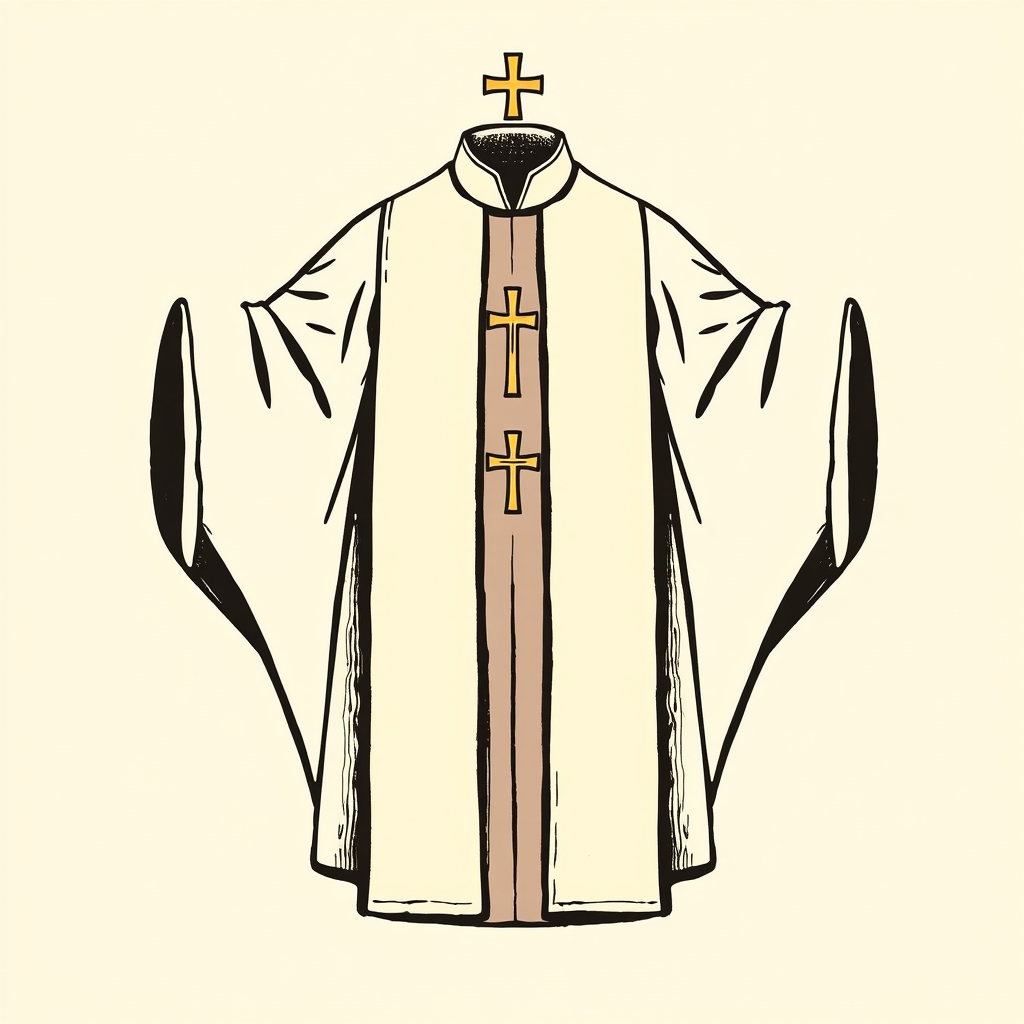
Signs and attributes

Entities
Narrative network
The names, places, and concepts most present in the entry, weighted by centrality in the text.
The supernatural in their life
The miracles of Saint Stapin of Dourgne
Frequently asked questions about Saint Stapin of Dourgne
Who was Saint Stapin of Dourgne?
Originally from Dourgne, Saint Stapin first led the life of a hermit before being elected Bishop of Carcassonne between the 7th and 8th centuries. Honored for his holiness in France, Italy, and Germany, he is particularly invoked for the healing of leg ailments. His cult remains active in Dourgne, where a church has been dedicated to him since the 17th century.
What is Saint Stapin of Dourgne the patron saint of?
Patronage of Saint Stapin of Dourgne: Dourgne, Ventenac and Carcassonne.
What is Saint Stapin of Dourgne invoked for?
Saint Stapin of Dourgne is invoked for: healing of leg ailments, podagra (gout) and bodily infirmities.
How is Saint Stapin of Dourgne depicted in Christian art?
In iconography, Saint Stapin of Dourgne is recognizable by: episcopal vestments and image of the Abbey of Arlobossa.
What miracles are attributed to Saint Stapin of Dourgne?
2 miracles are attributed to this saint, notably: Healing, Vision / apparition and Prophecy / infused knowledge.
Which saints were contemporaries of Saint Stapin of Dourgne?
Contemporaries include: Saint Hidulph of Trier, Saint Ghislain (Guillain), Saint Lambert (Landebert) and Saint Amand of Maastricht.
When did Saint Stapin of Dourgne die?
Saint Stapin of Dourgne died around 800.
What are the other names of Saint Stapin of Dourgne?
Other forms of the name: Stapin.
Annexes & related entities
Structured data for exploration: events, miracles, quotes, places, attributes, patronages, and important entities cited in the text.
Key Events
- Solitary and penitent life on a mountain near Dourgne
- Unanimous election to the episcopal see of Carcassonne following a divine revelation
- Establishment of an ancient cult attested by martyrologies from 1552
Quotes
-
patronus in podagra
Image from the Abbey of Arlobossa