Beatrice of Silva
A Portuguese noblewoman who became a nun in Toledo, Beatrice of Silva founded the Order of the Immaculate Conception (the Conceptionists) in 1484. Beatified in 1926 and canonized by Paul VI in 1976, her feast day is August 17.
Contemporaries

Figures and markers around the normalized period for this entry.
Guided reading
5 reading sections
Biography
A Portuguese noblewoman born around 1424, Beatrice of Silva spent part of her life at the Castilian court before retiring to a monastery in Toledo, where she died in 1492.
Beatrice of Silva (Beatriz de Menezes da Silva) was born around 1424 into a family of the high Portuguese nobility; sources link her to Campo Maior, in Alentejo, or to Ceuta, then under Portuguese rule. Her father, Ruy Gomes da Silva, and her mother, Isabel de Menezes, belonged to aristocratic lineages, and her brother, Blessed Amadeus of Silva (Amadeo), became a Franciscan reformer close to the papacy. Around 1447, Beatrice accompanied the Infanta Isabella of Portugal to Castile for her marriage to King John II of Castile, and lived for several years as a lady-in-waiting at the court. Weary of court life and desirous of dedicating herself to God, she left the court to retire to Toledo, at the Dominican monastery of Santo Domingo el Real, where she remained for many years in prayer. There, she matured the project of a religious foundation dedicated to the Immaculate Conception of the Virgin Mary. After giving birth to her order, she passed away in Toledo in 1492; sources hesitate between August 16 and 17, and some suggest the year 1490, but 1492 is the date most commonly accepted.
Life and Work
In 1484, Beatrice founded the Order of the Immaculate Conception in Toledo, whose rule was approved by Innocent VIII in 1489.
The major work of Beatrice of Silva was the foundation of a religious institute entirely dedicated to the Immaculate Conception of the Virgin Mary, a dogma then debated but deeply venerated in the Iberian Peninsula. In 1484, with a dozen companions, she took possession of a palace in Toledo placed at her disposal by Queen Isabella the Catholic, and transformed it into a monastery. The new community received pontifical approval through the bull Inter Universa of Pope Innocent VIII, dated April 30, 1489, which established the monastery under the title of the Conception of the Blessed Virgin Mary and approved its statutes, office, and habit. Beatrice desired for her nuns a symbolic habit: white robe and scapular, blue mantle, Marian colors recalling the purity of the Immaculate. In its beginnings, the community followed a discipline of Cistercian inspiration; after the death of the foundress, Pope Alexander VI united it in 1501 with a Benedictine community under the rule of Saint Clare, then Julius II definitively endowed the order with its own rule in 1511. From this foundation emerged the Order of the Conceptionists, a contemplative branch of the Franciscan family.
Journey toward holiness
Married to an intense Marian devotion, Beatrice's spirituality was marked by withdrawal from the world and, according to tradition, by an apparition of the Virgin.
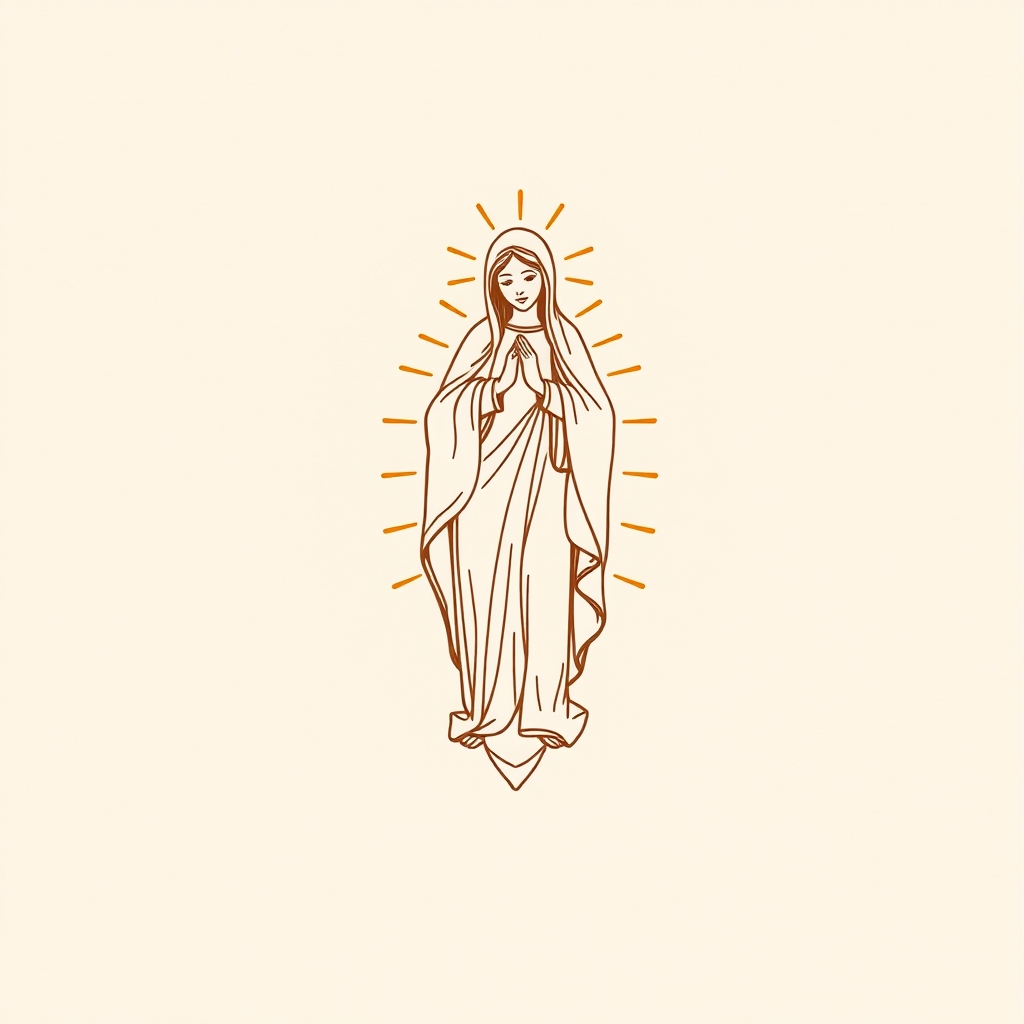
The spiritual journey of Beatrice of Silva is rooted in an ardent devotion to the Immaculate Conception, which guided her entire life. Hagiographic tradition reports that at the court of Castile, her beauty earned her jealousy and persecution; according to a widely circulated account, she was locked for several days in a chest, and it was during this ordeal that the Virgin Mary is said to have appeared to her, dressed in white and blue, inviting her to found an order dedicated to her Immaculate Conception. This account, characteristic of popular piety, must be received with the caution appropriate to late traditions. Beyond the marvelous, the sources agree on the coherence of her approach: the renunciation of a brilliant court life, a long contemplative retreat of several decades at the Dominican monastery of Toledo, and the perseverance to carry out a difficult foundation. Iconography attributes to her a star on her forehead, a sign of her Marian consecration, which is said to have disappeared at her death. Her reputation for holiness, attested from the modern era, was perpetuated for centuries in Conceptionist monasteries before leading to her official recognition by the Church.
Beatification and canonization
Beatified by Pius XI in 1926, Beatrice of Silva was canonized by Paul VI on October 3, 1976; her feast day is August 17.
The cult of Beatrice of Silva, long maintained in Conceptionist monasteries and in Portugal, was officially confirmed by Pope Pius XI, who declared her blessed on July 28, 1926, recognizing the immemorial veneration she enjoyed. The cause for canonization was then resumed in the mid-20th century. Pope Paul VI proceeded with her canonization on October 3, 1976, in St. Peter's Basilica in Rome, thus inscribing her in the catalogue of saints of the universal Church. Her liturgical memorial is fixed for August 17, the presumed day of her birth into Heaven, also observed by the order she founded; in the proper calendar of the Franciscan family, the celebration has sometimes been fixed for September 1. The Dicastery for the Causes of Saints maintains the entry for Beatrice of Silva Meneses among the saintly founders recognized by the Holy See.
Spirituality and heritage
The Order of the Immaculate Conception, born from her foundation, spread throughout Europe and the Hispanic world, perpetuating her Marian spirituality.
The legacy of Beatrice of Silva lies entirely in the Order of the Immaculate Conception (Order of the Immaculate Conception), which developed considerably after her death. Having become a contemplative branch of the Franciscan family, it spread throughout Spain, Portugal, and then into the territories of the Hispanic world, notably in Latin America, until it counted several hundred monasteries at its peak. The spirituality she bequeathed is centered on contemplation and on the mystery of the Immaculate Conception, of which the order was one of the promoters even before the dogmatic definition of 1854. The white habit with a blue mantle chosen by the foundress remains the distinctive sign of the Conceptionists. Venerated as the patroness and inspiring figure of the monasteries she brought forth, Beatrice of Silva remains honored in Portugal, her native land, and in Spain, in Toledo, where she lived and died. Her name is associated with the spread of devotion to the Immaculate in the Iberian Peninsula at the end of the Middle Ages.
Iconography
Signs and attributes

Frequently asked questions about Beatrice of Silva
Who was Beatrice of Silva?
A Portuguese noblewoman who became a nun in Toledo, Beatrice of Silva founded the Order of the Immaculate Conception (the Conceptionists) in 1484. Beatified in 1926 and canonized by Paul VI in 1976, her feast day is August 17.
What is Beatrice of Silva the patron saint of?
Patronage of Beatrice of Silva: Ordre de l'Immaculée Conception (Conceptionnistes) and Order of the Immaculate Conception (Conceptionists).
How is Beatrice of Silva depicted in Christian art?
In iconography, Beatrice of Silva is recognizable by: white habit and blue mantle of the Conceptionists, star on the forehead and apparition of the Virgin Mary.
Which saints were contemporaries of Beatrice of Silva?
Contemporaries include: Saint Peregrinus of Auxerre, Saint Philip Neri, Saint Ignatius of Loyola and Saint Colette (Nicole).
When did Beatrice of Silva die?
Beatrice of Silva died around 1492.
What are the other names of Beatrice of Silva?
Other forms of the name: Beatriz de Silva, Beatriz de Menezes da Silva and Beatrice de Silva Meneses.
Who are the relatives of Beatrice of Silva?
Relatives of Beatrice of Silva: Ruy Gomes da Silva (father), Isabel de Menezes (mother) and Amédée de Silva (bienheureux Amadeo) (brother).
Annexes & related entities
Structured data for exploration: events, miracles, quotes, places, attributes, patronages, and important entities cited in the text.
Key Events
- Era / death: 1424-1492
- Canonized in 1976 by Paul VI