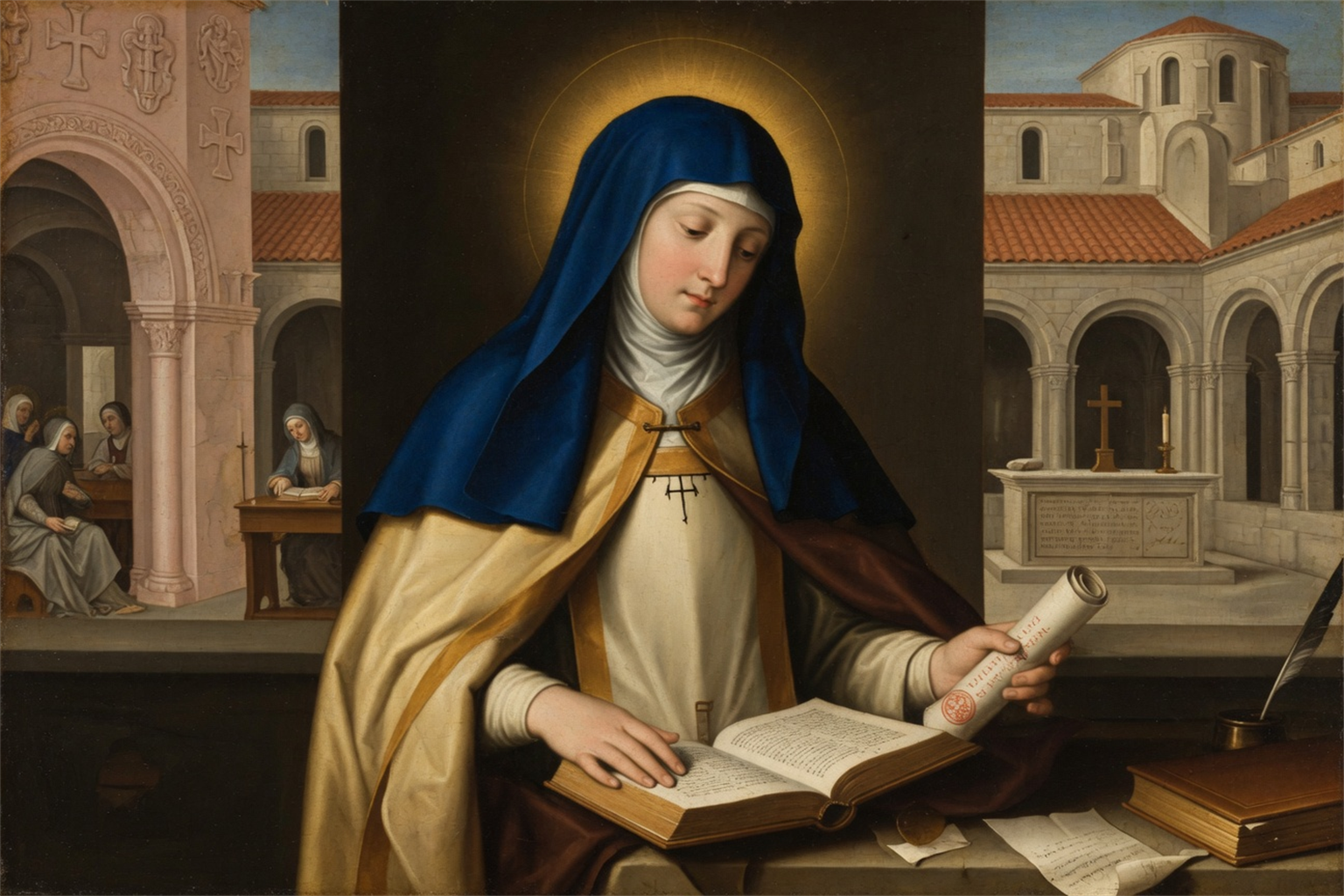
Saint Caesaria
Sister of Saint Caesarius of Arles, Caesaria was trained in Marseille before becoming the first abbess of the monastery built by her brother in Arles in 512. She established a rule of life there characterized by austerity, dedicated to prayer, work, and the copying of holy books. Her holiness and her rule influenced numerous communities, notably that of Saint Radegund in Poitiers.
Contemporaries

Figures and markers around the normalized period for this entry.
Guided reading
6 reading sections
SAINT CAESARIA, VIRGIN (540).
Education and formation in Marseille
From her childhood, Caesaria was placed in a monastery in Marseille to receive a rigorous religious education in preparation for her future responsibilities.
Caesari a, a virgin and si ster of Saint Caesarius, Bishop of Arles, was cloistered from a young age in a mona stery in Marseille to be raised there, so that, destined by the Lord for the guidance and governance of others, she might learn early on what she was to teach, and that she might be a student before becoming a mistress.
Foundation of the monastery of Arles
After the destruction caused by the siege of Arles in 510, her brother, Bishop Caesarius, completed the construction of a monastery where Caesaria established herself in 512.
Her brother had a monastery built for her which he was on the verge of completing when the Goths, besieged in the city of Arl es (5 10) by the Franks and the Burgundians, unfortunately destroyed all his work. But, once the siege was over, he resumed his labors, continued them until their full completion, and thus built a church, a cloister, and cells for the nuns. He dedicated this monastery in the tenth year of his episcopate, on August 26 (512). Caesaria first enclosed herself there with two or three sisters.
Life and discipline of the community
Many women join the community, living in enclosure, prayer, manual labor, and the study of sacred texts.
Soon a multitude of virgins, drawn by their example, came to join them, voluntarily leaving their possessions and their parents; courageously saying farewell to the pleasures of this world, fleeting flowers and messengers of our sad earth. They came to throw themselves into the arms and place themselves under the protection of Caesarius and Caesaria, their father and mother according to grace. There, they waited, their lamps lit, for the door of heaven to open for them, so that after having happily crossed the threshold of eternal happiness, they might enjoy without end the embraces of Christ, their divine spouse.
Retained by their own will within a cloister that allowed them only the sight of the sky, they would not leave it until the hour of their final passing. Prayer, penance, and work were their whole life; celebrating the glory of God in psalms, hymns, and canticles; engaging in pious reading, this was their only recreation. However, they also learned letters and copied the holy books.
Death of Caesaria and the influence of her rule
Caesaria died after establishing a holy rule that would influence other foundations, notably that of Saint Radegund in Poitiers.
After having laid the foundations of a holy rule, Caesaria, illustrious for her miracles, flew to Christ after a few years, on the 12th of January. The glory of her holiness had spread throughout the universe, and from her monastery came many families of virgins who kept the rule of Saint Caesaria; one of t he most famous was the one that Saint Radegund, wife of King Clotaire , instituted in the city of Poitiers and in which th is queen herself took the religious habit; she gave, in fact, as a rule to her Congregation, that of Saint Caesarius of Arles.
Succession and prosperity of the institution
A second Caesaria succeeded her, leading a community of two hundred nuns under the attentive protection of Saint Caesarius until his death.
Another Caesaria succeeded our Saint. She was the mother of two hundred nuns whom Saint Caesarius had the joy of seeing gathered in his monastery before his departure from this world. Thirty years had sufficed for this holy institution to reach this high degree of prosperity. The holy bishop lef t it rich not only in income and property, but above all in an excellent rule of life and a considerable sum of good examples. He took such great care of this Congregation that he had himself carried there by his servants three days before his death, to visit the Abbess Caesaria and the other nuns, to console them, to bless them, and to exhort them to the conquest of eternal life. As befitted a true pastor and a father full of days, he warned them to carefully keep the rule he had dictated to them a few years earlier. In his testament, he recommended them to the bishops his successors and submitted them to their direction.
Cult and Liturgy
The memory of Saint Caesaria is honored on January 28, particularly in the diocese of Aix.
The feast of Saint Caesaria is celebrated in the diocese o f Aix on January 28. Proper of Aix.
Iconography
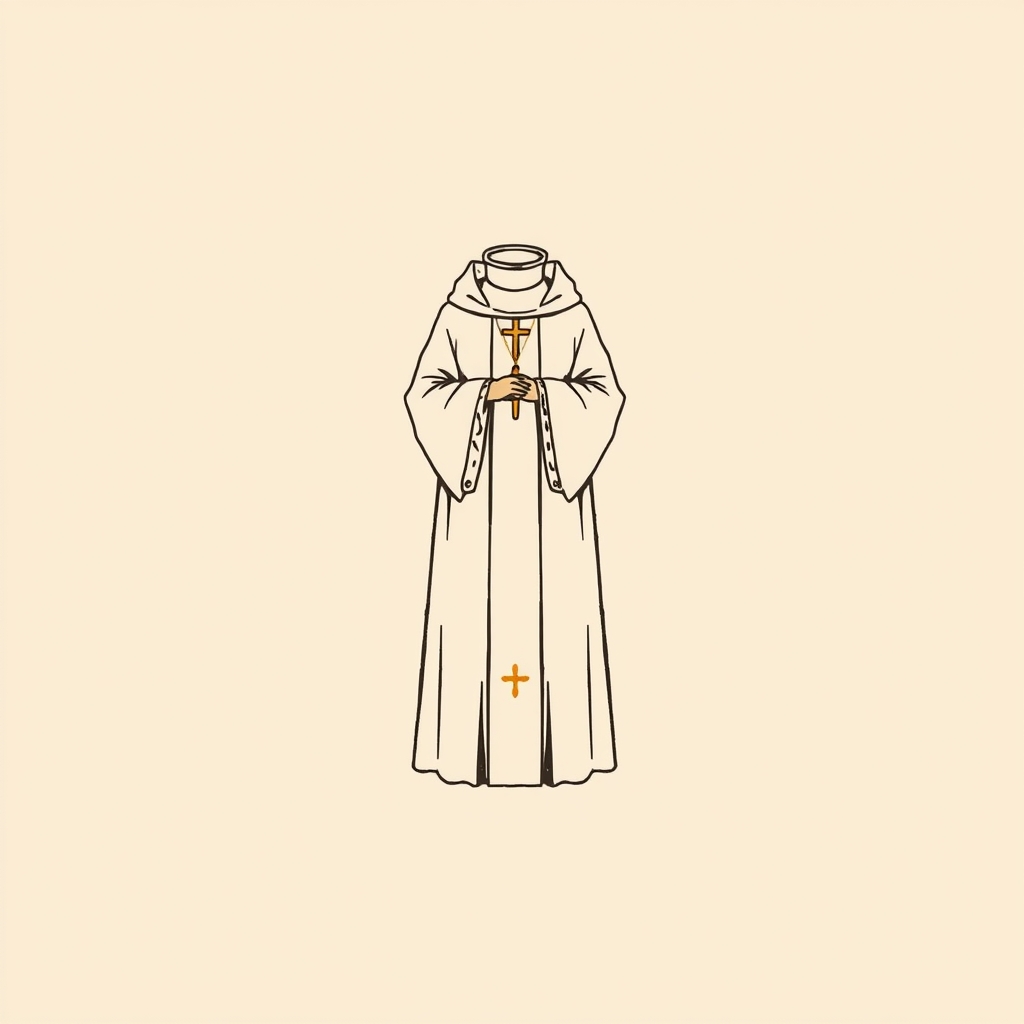
Signs and attributes

Entities
Narrative network
The names, places, and concepts most present in the entry, weighted by centrality in the text.
The supernatural in their life
The miracles of Saint Caesaria
Frequently asked questions about Saint Caesaria
Who was Saint Caesaria?
Sister of Saint Caesarius of Arles, Caesaria was trained in Marseille before becoming the first abbess of the monastery built by her brother in Arles in 512. She established a rule of life there characterized by austerity, dedicated to prayer, work, and the copying of holy books. Her holiness and her rule influenced numerous communities, notably that of Saint Radegund in Poitiers.
What is Saint Caesaria the patron saint of?
Patronage of Saint Caesaria: Monastery of Arles.
How is Saint Caesaria depicted in Christian art?
In iconography, Saint Caesaria is recognizable by: religious habit, book (copy of the holy books) and monastic rule.
What miracles are attributed to Saint Caesaria?
1 miracle are attributed to this saint, notably: Sign / wonder.
Which saints were contemporaries of Saint Caesaria?
Contemporaries include: Saint Remigius (Apostle of the Franks), Saint Antide of Besançon, Saint Eugene of Carthage and Saint Nicaise of Reims.
When did Saint Caesaria die?
Saint Caesaria died around 600.
Who are the relatives of Saint Caesaria?
Relatives of Saint Caesaria: Saint Césaire (brother).
Annexes & related entities
Structured data for exploration: events, miracles, quotes, places, attributes, patronages, and important entities cited in the text.
Key Events
- Educated at the monastery of Marseille from a young age
- Installation at the Arles monastery on August 26, 512
- Establishment of a monastic rule
- Direction of a community of virgins in Arles