Saint Onesimus of Soissons
Bishop of Soissons at the end of the 4th century and a contemporary of Saint Martin, Onesimus dedicated his episcopate to eradicating the remnants of Druidism and fighting against Arianism. He transformed pagan sites into Christian places and had the Basilica of Saint-Gervais and Saint-Protais built. He died at an advanced age after a life of deprivation and apostolic zeal.
Contemporaries

Figures and markers around the normalized period for this entry.
Guided reading
6 reading sections
SAINT ONESIMUS, BISHOP OF SOISSONS (late 4th century).
Struggle against the remnants of paganism
Onesimus strives to extirpate the roots of the Druidic cult in the Gallic countryside, transforming sacred natural sites into places of Christian devotion.
Onesimu s, a contemporary of Saint Hilary of Poitiers and Saint Martin of Tours , those illustrious pontiffs who cast so much glory upon the Church of the Gauls, imitated their zeal by working to extirpate from his diocese the remnants of idolatry that had survived the apostolic efforts of the first bishops, especially in the countryside, in the forests, and on the banks of rivers where the Druidic cult long retained some dominion. It may even be said that it could never be so thoroughly abolished that some reminiscence did not remain in the superstitions of which certain fountains and extraordinary stones are still the object today.
Moreover, to transform the idolatrous worship rendered to ancient trees and rocks by the ancient Gauls into a less superstitious cult, the bishops placed relics there, depicted crosses, and attached the memory of some Saint who would have replaced the divinity to whom they were originally dedicated. But the Druidic beliefs, carried over into the religious and naive customs of the people during the spread of Christianity, nonetheless remained heavily tainted with superstition.
These enormous sandstones, these sacred stones, which one sees near the churches at Brétigny, Neuilly-Saint-Front, Bitry, and Caisne, have been venerated at all times. It is true that, according to popular belief, these are saints who touched them, who rested upon them, who left the imprint of their footsteps as on the Saint-Martin stone at Autréches; but the confidence one has in their virtue, which is more than problematic, recalls only too well the gross errors of our fathers before their conversion to the faith.
Evangelization and miracles
The bishop converted the Soissons region through his preaching, baptisms, and numerous miracles, while protecting his flock from Arian heresy.
“O nesimus therefore applied himself to submitting the Soissons region , where the powe r of the demon still dominated, to the light yoke of the Gospel. Everywhere the altars of false gods are overturned, and the pagan temples destroyed.” He administered baptism to numerous neophytes and performed, in the Soissons valley, many miracles necessary for the tender infancy of this nascent Church. He also strove to preserve it from the Arian heresy that had reached the Gauls.
The support of imperial power
Despite the interlude of Julian the Apostate, Onesimus's actions took place during the period of the definitive proscription of paganism under Emperor Theodosius.
Gallo-Roman bishops were all the more successful in their endeavors for the advancement of Christianity as they were better supported by the imperial power. Julian the Apostate had indeed made some efforts for the restoration of paganism, but, besides the fact that this absurd cult could not withstand the lights of the faith, T heodosiu s soon made these fleeting attempts forgotten by decreeing the closure of temples and the definitive proscription of the old dying cult (393-395).
A life of asceticism and piety
Of a fragile constitution, Onesimus led a life of privations and voluntary sufferings, compared to a continual martyrdom.
Onesimus, like his colleague Martin of Tours, joined to the ardent speech of an apostle an exemplary piety, the love or rather the passion for suffering, the contempt for riches, and the aversion to pleasures. Of a weak and sickly constitution, he knew how to dominate through the power of his soul the infirmities of a body wracked by pain. He had vowed against himself a hatred that made his life a continual martyrdom.
Death and posterity of the relics
Dying at the end of the 4th century, he was first buried in Crouy before his relics were transferred to Douai and then Donchery.
His death was so edifying and so full of merit that the faithful, who had regarded him as a Saint during his lifetime, canonized him with a unanimous voice after his passing, which occurred in extreme old age on the 3rd of the Ides of May (May 13), towards the end of the fourth century. He was buried in the chapel of Saint-Georges located in the cemetery of the same name, in the fisc of Crouy.
According to the historian of the metropolis of Reims, the body of Saint Onesimus was subsequently transferred to the church of the monastery that rose on the site of the imperial domain of Crouy, where it remained for ninety years, after which it was taken to the church of Saint-Amand in Douai, whose monks, in the 10th century, gave a portion of it to the priory of Donchery, near Sedan, which depended on the abbey of Saint-Médard.
Foundation of the Cathedral of Soissons
Onesimus is credited with the construction of the Basilica of Saints Gervasius and Protasius, which became the cathedral and the seat of the diocese.
In the absence of any historical monument, it may be conjectured that it was Saint Onesimus who built, at the end of the 4th century, around 388, on the site of the former oratory dedicated to the Blessed Virgin, the Basilica of Saints Gervasius and Protasius , when Saint A mbrose, having discovered their precious relics, distributed, according to Gregory of Tours, a portion among several cities of Gaul and Italy.
According to all probabilities, this basilica, dedicated from time immemorial to the Blessed Virgin and to these two Saints, was from then on the Mother Church (Matrix Ecclesia), the head of the city and of the entire diocese, the one where the bishop sat in his chair (cathedra), surrounded by the elite of his clergy, the cathedral, in a word, which is only authentically mentioned in 646 and which appears to have always existed through all its architectural transformations, at the place it occupies today, in the pure splendor of the great style of the Middle Ages.
Excerpt f rom the Annals of the Church of Soissons.
Iconography
Signs and attributes
Entities
Narrative network
The names, places, and concepts most present in the entry, weighted by centrality in the text.
The supernatural in their life
The miracles of Saint Onesimus of Soissons
Frequently asked questions about Saint Onesimus of Soissons
Who was Saint Onesimus of Soissons?
Bishop of Soissons at the end of the 4th century and a contemporary of Saint Martin, Onesimus dedicated his episcopate to eradicating the remnants of Druidism and fighting against Arianism. He transformed pagan sites into Christian places and had the Basilica of Saint-Gervais and Saint-Protais built. He died at an advanced age after a life of deprivation and apostolic zeal.
What is Saint Onesimus of Soissons the patron saint of?
Patronage of Saint Onesimus of Soissons: Diocese of Soissons.
How is Saint Onesimus of Soissons depicted in Christian art?
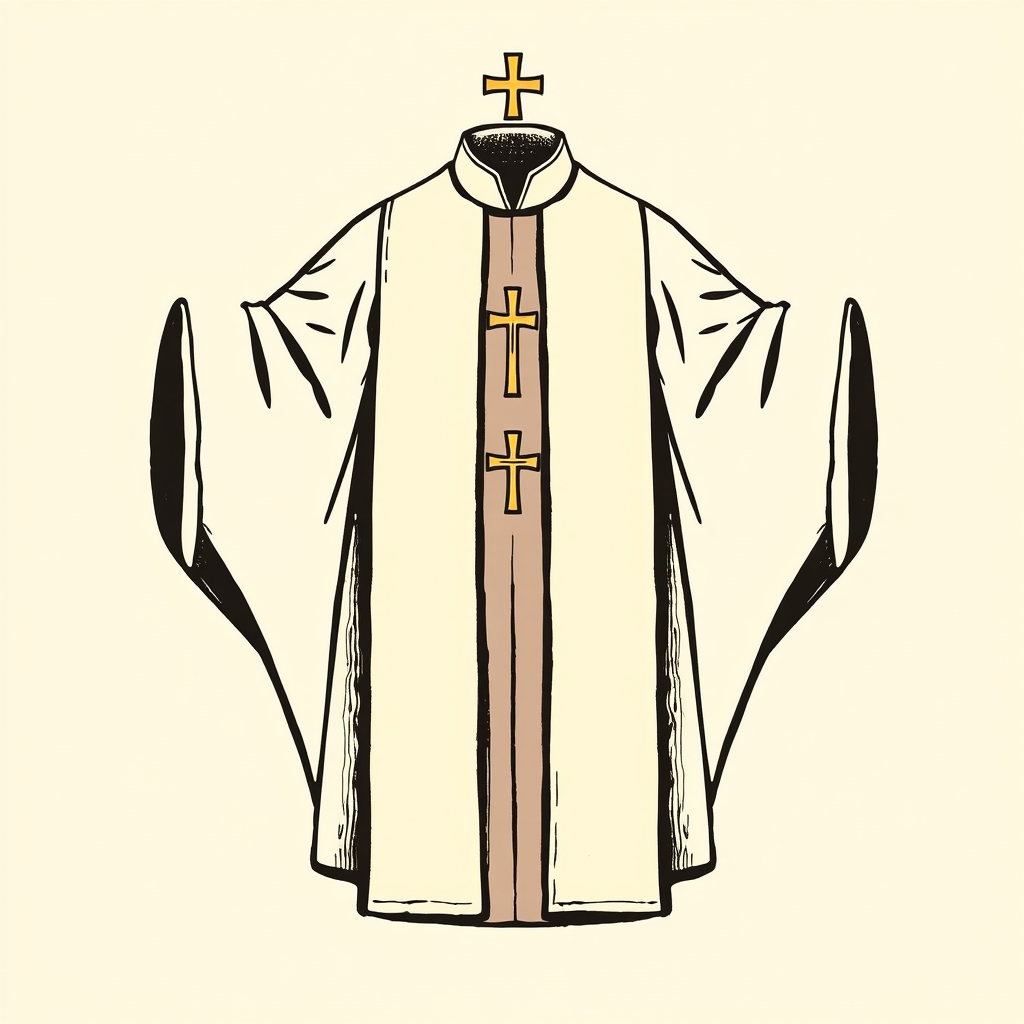
In iconography, Saint Onesimus of Soissons is recognizable by: episcopal vestments and cross.
What miracles are attributed to Saint Onesimus of Soissons?
1 miracle are attributed to this saint, notably: Sign / wonder and Conversion.
Which saints were contemporaries of Saint Onesimus of Soissons?
Contemporaries include: Saint Blaise, Saint Hilary of Poitiers, Saint Basil the Great (Archbishop of Caesarea) and Saint Baudilus.
When did Saint Onesimus of Soissons die?
Saint Onesimus of Soissons died around 400.
Annexes & related entities
Structured data for exploration: events, miracles, quotes, places, attributes, patronages, and important entities cited in the text.
Key Events
- Struggle against Druidic idolatry in the countryside and forests
- Christianization of pagan places of worship (stones, fountains, trees)
- Administered baptism to numerous neophytes
- Struggle against the Arian heresy
- Presumed construction of the Basilica of Saint-Gervais and Saint-Protais around 388
- Died at an extreme old age