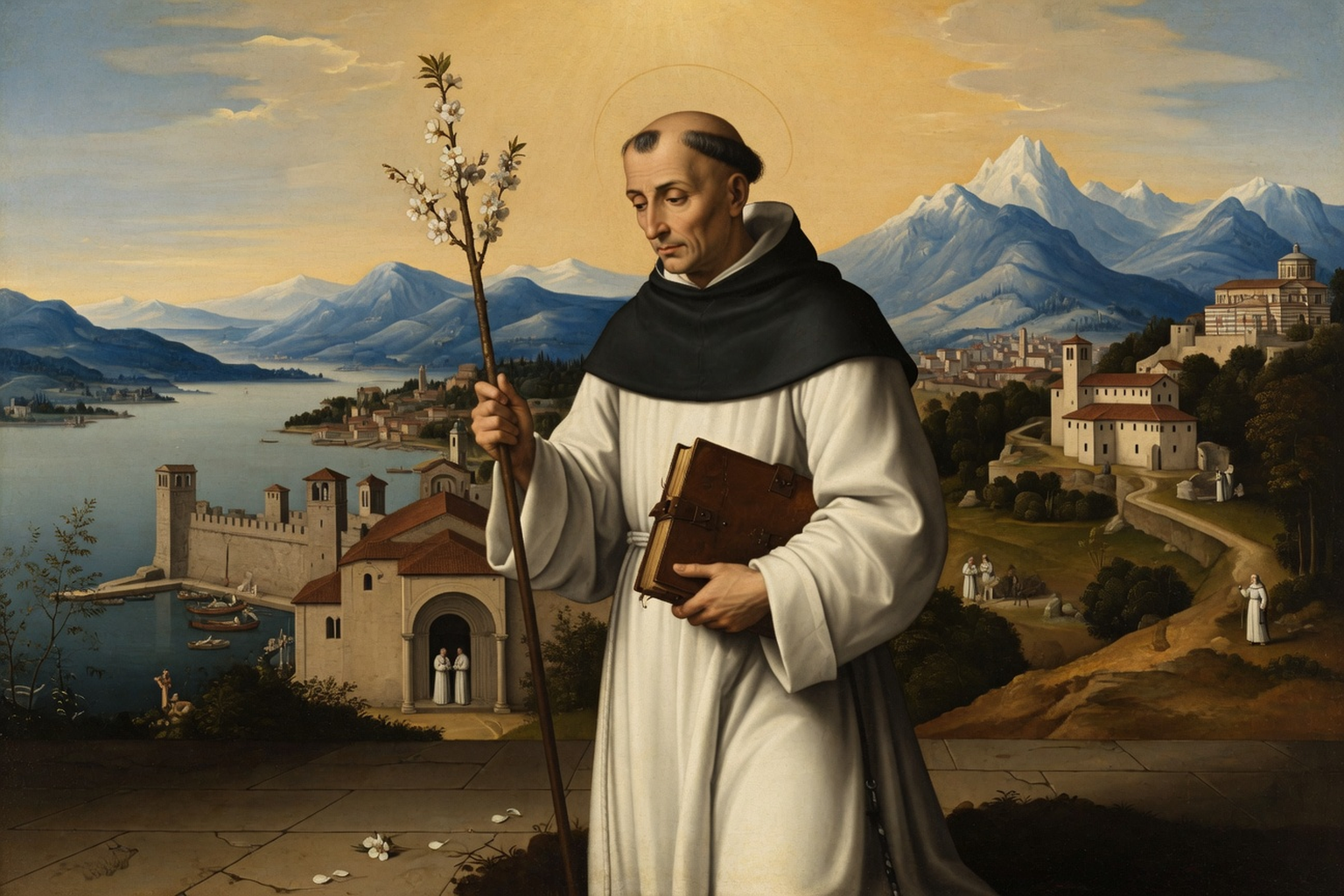
An Italian Dominican of the 15th century, André Grego distinguished himself by his austerity from childhood and his refusal of a brilliant marriage. Nicknamed the Apostle of the Valtellina, he dedicated forty-five years to evangelizing the Alps, founding churches and monasteries to counter heresies. He died in 1485 in Morbegno, leaving behind a reputation as a miracle worker.
Contemporaries

Figures and markers around the normalized period for this entry.
Guided reading
6 reading sections
SAINT ANDREW OF PESCHIERA (1485).
Youth and early asceticism
Born in Peschiera, Andrew manifested a rigorous piety from childhood, practicing fasting and prayer while refusing worldly pleasures.
Andrew Greg o was b orn in Pe schiera, on the shores of Lake Garda, in the diocese of Ve rona, to poor and pious parents. The holiness to which he would one day attain was foreshadowed from his earliest childhood. Indeed, he was accustomed to abstaining from the amusements of childhood, to applying himself to prayer, to refusing foods that flatter the palate, and even to spending the entire Lent taking nothing but bread and water, a habit he maintained until his death. As he grew, the rare beauty of his body developed, united in him with a great love of chastity. A brilliant marriage was offered to him: he refused it with modesty, but with a glorious firmness that nothing could shake. Without having been to any school other than that of divine grace, he had learned to find his delight solely in the study of the Holy Scripture; he seemed to be called to the Lord as to the portion reserved for his destiny.
Family conflicts and entry into religious life
After his father's death, he endured the malice of his brothers before leaving for Brescia to embrace religious life, marking his departure with a miracle.
After the death of his father, whose family affairs he had been left to manage despite his own wishes, he had to endure many indignities from his two brothers, to the point that he was sometimes forced to sleep outside the house because of their malice. But after having suffered everything with admirable patience, his pious mother, who took pity on her son's sad fate, gave him her blessing and consent, and he was able to withdraw to Brescia to embrace the religio us life , which had long been the object of his prayers.
On this occasion, a remarkable event occurred: his brothers having accompanied him to the city gate, at the moment of leaving them, after having humbly kissed their feet, he gave them his staff as a keepsake, which was almost all he had taken from his father's house; this staff having subsequently blossomed miraculously and performed wonders, the inhabitants of Peschiera held it in great honor.
Formation in Florence
He joined the Dominican Order and completed his formation at the monastery of San Marco in Florence under the guidance of Blessed Anthony of Chiesa.
In the D ominican family, he put on the new man, the perfect man. Sent to Florence t o pursue his studies, and received at the mon astery of San Marco whe re, through the care o f Blessed Anthony of Chiesa, the discipline of the rule was very flourishing, he raised his soul there to the pinnacle of all virtues. He gave himself above all entirely to obedience and he was accustomed to saying that the word *obedient* sounded to his ear like that of saint.
Apostolate in Valtellina and Switzerland
Sent on a mission to Valtellina and Rhaetia, he fought against heresies through his preaching, his austerity, and his moral authority.
Having become fit for apostolic duties, he set out, by the order of his superiors, to go to southern Switzerland (Rhaetian society), with Brother Dominic of Pisa, whom Benigno de' Medici, a very pious man, had engaged to conduct missions in Valtellina and the neig hboring cantons, a province that Saint Dominic and the venerable Pagan of Como, inquisit or for the Catholic faith, had undertaken to purge of all the errors with which it was infected.
It is not easy to say with what ardor and zeal the young apostle set about clearing it, how many errors he uprooted, or how many strayed souls he brought back to the right path. There was not a hamlet so small, nor a hill so inaccessible, that he did not go there to win souls, preferring to lodge with the poor, sleeping on a bed of branches, feeding only on millet bread, and drinking only pure water. His authority among all classes of citizens soon became such that his mere presence was enough to calm the tumult of furious crowds, and that he brought the most stubborn heretics to submit to the Church gently and irresistibly through short discussions. All venerated in him the father of the poor, the apostle of Valtellina, and the envoy of God Himself.
Foundations and death
He founded several churches and the monastery of Morbegno before passing away after forty-five years of apostolate.
To consolidate the faith for the future, to preserve good morals, he built churches, increased the number of parishes, and founded monasteries, among others that of Morbegno, of the Friars Pr eachers, which h e set up as a bulwark against the assaults of heresies and bad morals. After forty-five years of apostolate and a life brilliant with miracles attested by the monuments of the time, he could never be made to accept the high offices of his order; he was content with that of questor.
Finally, the man of God, after having accomplished incredible labors through the valleys and the mountains, in the midst of factories and ice, until the most extreme old age, was struck by a mortal illness. He announced the day of his death in advance, received the sacraments, and fell asleep peacefully in the Lord, amidst the tears of his brothers, in the year 1185, on January 18. His body, which exhaled a pleasant odor, was first buried in a very modest tomb, amidst a great gathering of people; but, subsequently, it was twice solemnly transferred and deposited in Morbegno, in the church of his order, where he is the object of great veneration.
Official recognition of the cult
In 1820, Pope Pius VII confirmed his cult for the Dominican Order and the Diocese of Verona.
On September 23, 1820, the Sovereign Pontif f Pius VII approved his cult, which had never been interrupted, and, upon consultation with th e Sacred Congregation of Rite s, granted permission to celebrate his office with Mass throughout the Order of Preachers and in the Diocese of Verona. Dominican Breviary.
Iconography
Signs and attributes


Entities
Narrative network
The names, places, and concepts most present in the entry, weighted by centrality in the text.
The supernatural in their life
The miracles of Saint Andrew of Peschiera (Andrew Grego)
Frequently asked questions about Saint Andrew of Peschiera (Andrew Grego)
Who was Saint Andrew of Peschiera (Andrew Grego)?
An Italian Dominican of the 15th century, André Grego distinguished himself by his austerity from childhood and his refusal of a brilliant marriage. Nicknamed the Apostle of the Valtellina, he dedicated forty-five years to evangelizing the Alps, founding churches and monasteries to counter heresies. He died in 1485 in Morbegno, leaving behind a reputation as a miracle worker.
What is Saint Andrew of Peschiera (Andrew Grego) the patron saint of?
Patronage of Saint Andrew of Peschiera (Andrew Grego): Valtellina, Morbegno and Peschiera.
What is Saint Andrew of Peschiera (Andrew Grego) invoked for?
Saint Andrew of Peschiera (Andrew Grego) is invoked for: calming of crowds and conversion of heretics.
How is Saint Andrew of Peschiera (Andrew Grego) depicted in Christian art?
In iconography, Saint Andrew of Peschiera (Andrew Grego) is recognizable by: Dominican habit, flowered staff and book (Holy Scripture).
What miracles are attributed to Saint Andrew of Peschiera (Andrew Grego)?
4 miracles are attributed to this saint, notably: Sign / wonder and Prophecy / infused knowledge.
Which saints were contemporaries of Saint Andrew of Peschiera (Andrew Grego)?
Contemporaries include: Saint Peregrinus of Auxerre, Saint Philip Neri, Saint Ignatius of Loyola and Saint Colette (Nicole).
When did Saint Andrew of Peschiera (Andrew Grego) die?
Saint Andrew of Peschiera (Andrew Grego) died around 1485.
What are the other names of Saint Andrew of Peschiera (Andrew Grego)?
Other forms of the name: André Grego and Andreas de Peschiera.
Who are the relatives of Saint Andrew of Peschiera (Andrew Grego)?
Relatives of Saint Andrew of Peschiera (Andrew Grego): Inconnu (father), Inconnue (mother) and Inconnus (two brothers).
Annexes & related entities
Structured data for exploration: events, miracles, quotes, places, attributes, patronages, and important entities cited in the text.
Key Events
- Joined the Order of Preachers in Brescia
- Studies at the monastery of San Marco in Florence
- Apostolic mission in Valtellina and southern Switzerland
- Foundation of the monastery of Morbigne
- Approval of cult by Pius VII in 1820
Quotes
-
The word obedient rings in my ear like that of saint.
Oral tradition reported in the text