Christina of Stommeln
A 13th-century Rhenish mystic and beguine, Christina of Stommeln is known for her intense mystical experiences, stigmata, and deep spiritual friendship with the Dominican Peter of Dacia.
Contemporaries

Figures and markers around the normalized period for this entry.
Guided reading
5 reading sections
Biography
The youth of Christina Bruso, her flight to join the Beguines of Cologne, and her return to Stommeln.
Blessed Christina von Stommeln (also known as Christine Bruso or Bruzo) was born on July 24, 1242, in Stommeln, a village located northwest of Cologne, Germany. Coming from a family of prosperous farmers, Heinrich and Hilla Bruso, she manifested an extraordinary spiritual sensitivity from a very young age. At the age of five, she began to experience mystical visions, notably of the Child Jesus. Around the age of ten, she received a call in a dream to live among the Beguines.
At the age of twelve or thirteen, to escape a marriage arrangement planned by her parents, she fled the family home without their consent to join a community of Beguines in Cologne. There, she led a life of extreme austerity and penance. However, her intense mystical experiences, her trances, and the early appearance of stigmata (the wounds of Christ on her hands, feet, head, and side) aroused the misunderstanding and suspicion of her companions. Accused of madness and treated with contempt, she was forced to leave the Cologne community in 1267 to return to her native village. There, she was welcomed and spiritually supported by the parish priest, a man named Johannes.
Life and Work
Her spiritual relationship with Peter of Dacia, her mystical trials, and her secluded life after his death.
In December 1267, Christina had an encounter that would profoundly mark her life: that of Peter of Dacia (Petrus de Dacia), a young Swedish Dominican friar who had come to study in Cologne under the direction of Albert the Great. A spiritual friendship of rare intensity developed between them. Peter became her spiritual director, her confidant, and her biographer. Even after Peter's return to Sweden, their bond was not broken; they maintained a regular epistolary correspondence and visited each other many times (about sixteen visits) over a period of more than twenty years. It is through the writings of Peter of Dacia, notably his Vita Christinae Stumbelensis, that Christina's mystical life has come down to us. He describes in detail her ecstasies, the periodic reappearance of her stigmata (particularly during Holy Week), as well as the violent physical and spiritual assaults she suffered from the demon. Christina endured these trials with heroic patience, offering her sufferings in union with the Passion of Christ. After the death of Peter of Dacia in 1288 (or 1289), all extraordinary mystical manifestations and diabolical attacks ceased abruptly. Christina then left the priest's house to settle in a small cloister or hermitage in Stommeln. There, she led a retired, humble, and peaceful life, devoted to silent prayer and works of charity until her death.
Path to Holiness
The death of Christina, the veneration of her tomb, and the successive translations of her relics to Jülich.
Christina passed away on November 6, 1312, in Stommeln, at the age of 70, wearing her beguine habit. She was initially buried in the parish cemetery of Stommeln, against the church wall, which already testified to the veneration held for her by her contemporaries. Her tomb quickly became a site of local pilgrimage where numerous spiritual and physical favors were reported.
Due to popular fervor, her relics were the subject of several translations over the centuries: * In 1342, they were transferred to Nideggen. * In 1569 (or 1586 according to local archives), in order to preserve them from the troubles linked to the Protestant Reformation, her remains were transferred to the Propsteikirche (provost church) of Jülich in the Rhineland, where a monument was erected in her honor.
On November 16, 1944, during an Allied aerial bombardment that almost entirely destroyed the church of Jülich, the reliquary containing her remains (notably her cranial relic) was miraculously found intact under the rubble. Her relics are still piously preserved and venerated there today.
Beatification and canonization
The official recognition of her cult by Pope Saint Pius X in 1908.
The cult of Christina of Stommeln was officially recognized and confirmed by Pope Saint Pius X on August 12, 1908 (some sources mention the decree of August 22, 1908, or a solemn celebration on November 8, 1908, at Saint Peter's Basilica) through an equipollent beatification. She is inscribed in the Roman Martyrology as blessed, and her liturgical feast is set for November 6, the anniversary of her death.
Spirituality and legacy
Christina's Christocentric spirituality, her spiritual friendship with Peter of Dacia, and her artistic representations.
Christina of Stommeln is one of the most singular figures of 13th-century Rhenish mysticism and the Beguine movement. Her spirituality is deeply Christocentric, centered on the contemplation and sharing of the sufferings of Christ's Passion. Through her stigmata and the physical and spiritual trials she endured, she lived a theology of compassion, offering her life for the relief of the souls in purgatory and the conversion of sinners.
Her legacy also resides in the testimony of her spiritual friendship with Peter of Dacia. Their correspondence, which constitutes one of the first literary documents of this type in the Middle Ages, shows how a human and spiritual relationship can become a path of mutual sanctification and theological deepening.
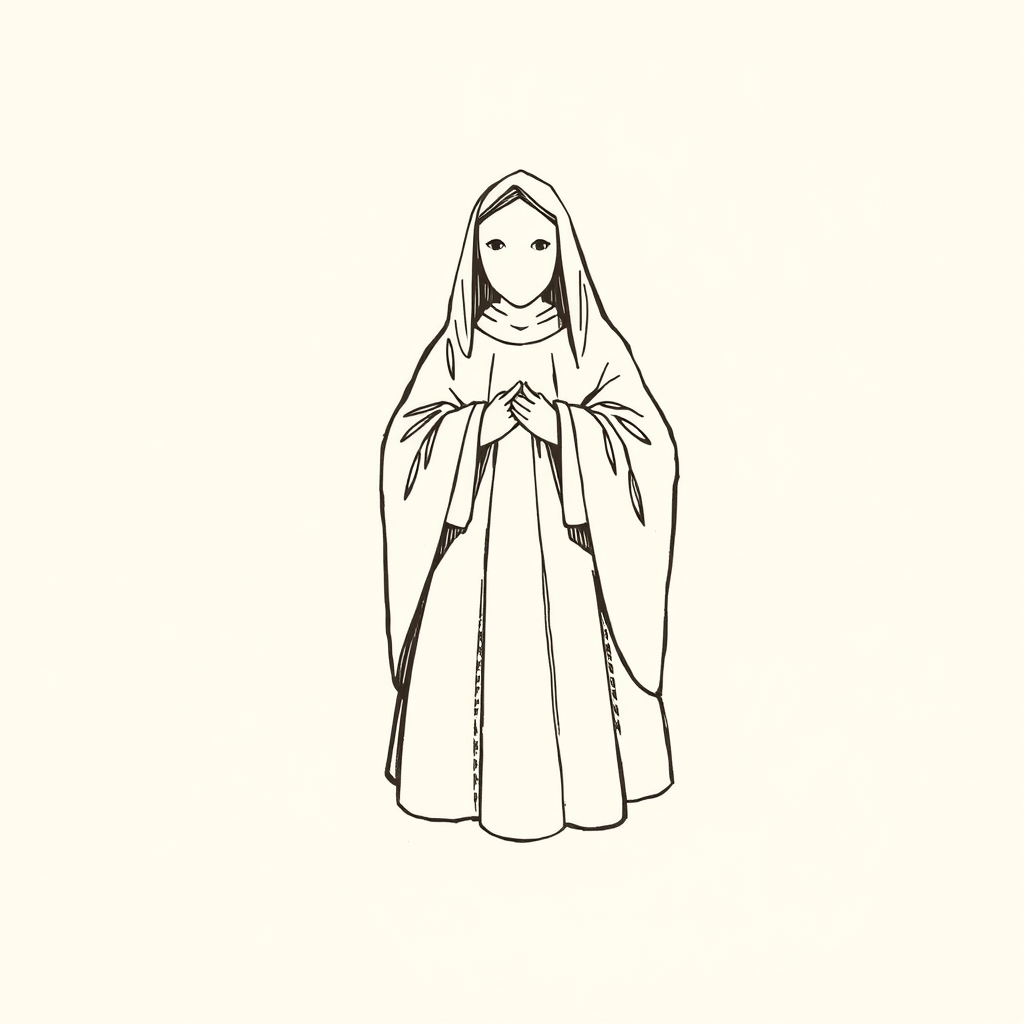
In Christian art, she is depicted wearing the Beguine habit, bearing the stigmata, or facing the temptations of the demon. A statue of the blessed also adorns the north portal of Cologne Cathedral, recalling her historical and spiritual anchoring in the Rhenish region.
Iconography
Signs and attributes

Frequently asked questions about Christina of Stommeln
Who was Christina of Stommeln?
A 13th-century Rhenish mystic and beguine, Christina of Stommeln is known for her intense mystical experiences, stigmata, and deep spiritual friendship with the Dominican Peter of Dacia.
How is Christina of Stommeln depicted in Christian art?
In iconography, Christina of Stommeln is recognizable by: Beguine habit and stigmata.
Which saints were contemporaries of Christina of Stommeln?
Contemporaries include: Saint Anthony of Padua (Ferdinand), Saint Arthaud of Belley, Saint Thomas Aquinas and Saint Bernard of Clairvaux.
When did Christina of Stommeln die?
Christina of Stommeln died around 1300.
What are the other names of Christina of Stommeln?
Other forms of the name: Christine Bruso, Christine Bruzo and Christina von Stommeln.
Who are the relatives of Christina of Stommeln?
Relatives of Christina of Stommeln: Heinrich Bruso (father) and Hilla Bruso (mother).
Annexes & related entities
Structured data for exploration: events, miracles, quotes, places, attributes, patronages, and important entities cited in the text.
Key Events
- Era / death: 1312
- Beatification in 1908 by Pius X