
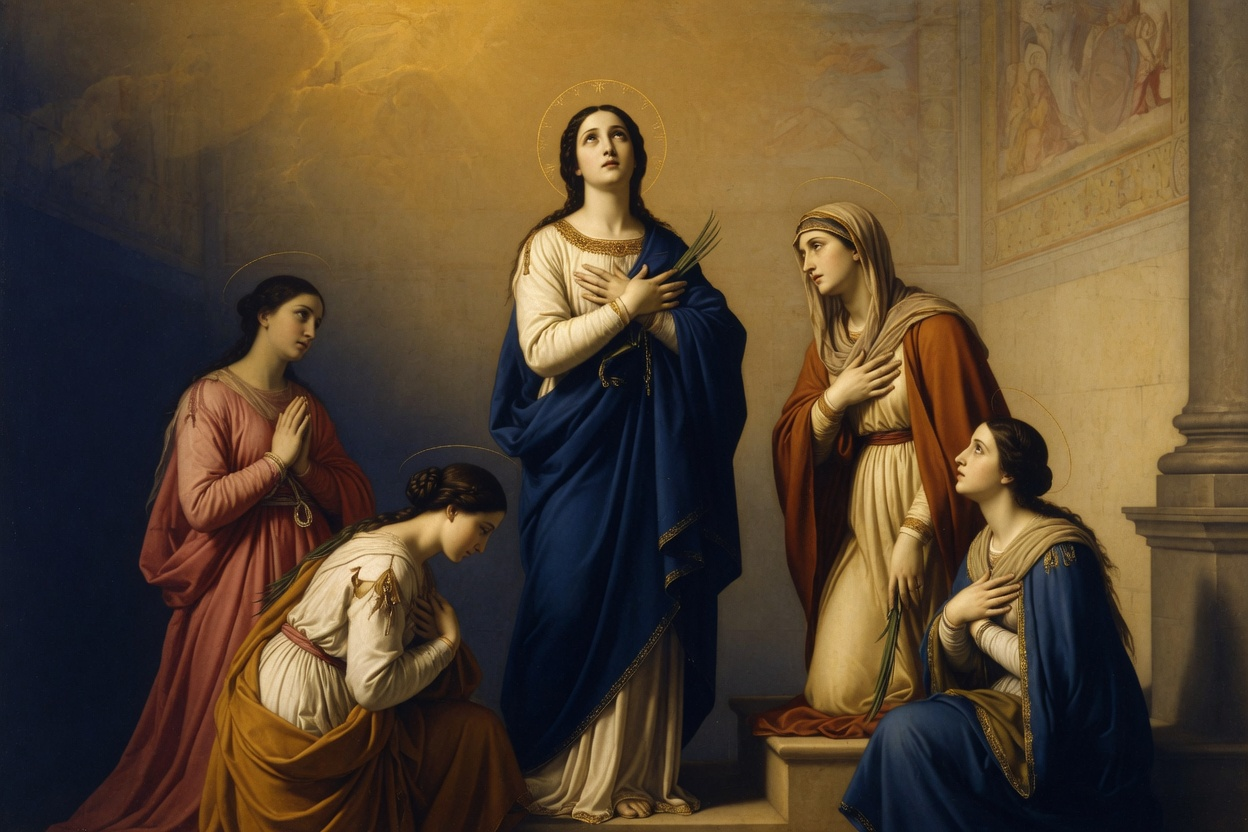
Saint Basilissa, Saint Callinice and Their Three Companions
SAINT MATIDIA, SISTER OF TRAJAN, AND THE VENERABLE DROSELLA, DAUGHTER OF THIS EMPEROR (116).
The account from the Petits Bollandistes presents Basilissa, Callinice and three Christian companions in Rome. It relates their assistance to martyrs, their links with Drosella and Matidia, and then their execution under Trajan, dated around 116 by the work.
Contemporaries

Figures and markers around the normalized period for this entry.
Guided reading
2 reading sections
SAINT BASILISSA, SAINT CALLINICE, AND THEIR THREE COMPANIONS
SAINT MATIDIA, SISTER OF TRAJAN, AND THE VENERABLE DROSELLA, DAUGHTER OF THIS EMPEROR (116).
Basilissa, Callinice and Their Companions
Around the year 116 of Jesus Christ, there lived in Rome, in a house not far from the palace of the Emperor Trajan, five Christian maidens who devoted themselves to the practice of the evangelical counsels: their gathering was like a small convent, which shows that religious life began with Christianity, although it was organized and regulated only later by Saint Anthony, Saint Macarius, Saint Syncletica, Saint Basil, Saint Caesarius, Saint Benedict, etc.
History has forgotten the names of three of these virgins: of the other two, one was named Basilissa and the second Callinice. These holy maidens engaged in good works outside, as much as the time of persecution in which they lived allowed. Following the example of most holy women of the first centuries of the Church, they especially collected and buried with zeal the bodies of the martyrs.
Now it happened that a daughter of the emperor, named Drosella, already a catechumen, doubtless persuaded by her aunt Saint Matidia, heard of the way of life of these holy spouses of Jesus Christ, and sought their company. Often, during the night, she slipped away from the imperial palace, and, accompanied by a few attendants, came to take part in the exercises of the pious community. Despite the most meticulous precautions, these outings aroused suspicion: they were warned by one of the emperor's advisors, named Adrian, who aspired to the hand of the former. Trajan, informed, ordered soldiers to watch everyone leaving the palace, to follow them to the place they were going, and to bring them back by force along with their accomplices. The opportunity was not long in coming: one evening, the guards saw, though without recognizing her, the princess secretly leaving with her companions: they followed them to the house of the five pious virgins and arrested the whole holy assembly in the name of the emperor. Imagine the astonishment and anger of Trajan when the next day he saw his daughter among these abhorred Christians. He began by placing her in solitary confinement in a room of the imperial residence, where everything was attempted, though in vain, to tear the faith from her heart. Then he had the five Christian women brought before him, whom he considered guilty of treason. As they refused to find evil in what was good and to burn incense to idols, he condemned them to a punishment hitherto unheard of. They stripped these pure virgins of all their clothes; they gathered them together in the same tub and poured molten tin and lead over their bodies. The innocent doves were not long in expiring in this horrible torment, and their souls went to heaven to immerse themselves in the bath of eternal delights. It was March 21 of the year 116, approximately.
To insult the Christians, and above all to insult a virtue unknown in the world before them—holy modesty—Trajan ordered that the cauldron, the lead, and the tin used for the execution be melted down, and that with it all five statuettes of vestals be made and displayed naked at the entrance of the bath where the martyrdom of the five virgins had taken place—so deeply had corruption entered into pagan customs! so deeply was human nature mired in the slough! so little awareness did the world have, before Jesus Christ, of its horrible degradation!
This is perhaps the moment to say a word about the origin of monasteries for women.
As early as the second century—all ecclesiastical histories attest to it, the menologies of the Greeks speak of it—there were women who, individually or in community, led the pure life of virgins: they served the priests out of charity or piety. Hence their name Agapetae, which expresses their mission of devotion. There were also deaconesses who especially assisted with the administration of baptism, as long as this Sacrament was administered by immersion. But they were not nuns in the sense that has since been attached to this word: they were so in substance, not in form. They lived in their own homes, alone or gathered in small numbers; they did not refrain from external works of mercy—just like our modern congregations—and withdrew by this kind of voluntary secluded life from the whirlwind of the world. As for the first founder of monasteries for women or widows properly so called, it is difficult to designate her with certainty. Most, however, recognize Saint Syncletica, a contemporary of Saint Anthony, as the mother and founder of the first nuns properly so called. Could it be because we possess Saint Syncletica's instructions to her nuns and because the admonitions of no other have reached us that general opinion has declared in her favor? This seems quite probable to us. People have become so accustomed to accepting ready-made opinions when they do not contradict apostolicity—one of the marks of the true Church—that we are tempted to believe so. Be that as it may, we have just seen a small convent in full practice in Rome from the beginning of the 2nd century. Because Saint Basilissa, Saint Callinice and their companions did not leave us a code of religious rules, does that mean they were not true nuns as to the practice of the evangelical counsels? Simple reason leads us to see clearly that the Gospel was practiced as perfectly, if not more so, at the cradle of the Church as in subsequent centuries. Therefore, in our opinion, there have always been monks and solitaries, nuns and religious, persons of both sexes making prayer and the exercise of works of mercy their sole occupation.
Source and Editorial Note
This entry reproduces the historical text from the Petits Bollandistes, proofread against digitized pages. The traditions and assessments of the author belong to the era of the work.
Paul Guérin, Les Petits Bollandistes, volume 3, p. 590–591. Digitized copy by the Bibliothèque nationale de France: https://gallica.bnf.fr/ark:/12148/bpt6k30733g
Editorial note: This hagiographical account is reproduced according to the Petits Bollandistes. Its chronology and the family ties attributed to the imperial figures are those of the ancient source. In this text, the execution concerns the five virgins; Drosella is confined separately at the palace.
Frequently asked questions about Saint Basilissa, Saint Callinice and Their Three Companions
Who was Saint Basilissa, Saint Callinice and Their Three Companions?
The account from the Petits Bollandistes presents Basilissa, Callinice and three Christian companions in Rome. It relates their assistance to martyrs, their links with Drosella and Matidia, and then their execution under Trajan, dated around 116 by the work.
How did Saint Basilissa, Saint Callinice and Their Three Companions die?
Saint Basilissa, Saint Callinice and Their Three Companions suffered martyrdom for the Christian faith (2nd century).
Which saints were contemporaries of Saint Basilissa, Saint Callinice and Their Three Companions?
Contemporaries include: Saint Dionysius the Areopagite (First Bishop of Paris), Saint Pothinus and his companions (Martyrs of Lyon), Saint Benignus of Smyrna and Jesus Christ (Relics of the Passion).
What are the other names of Saint Basilissa, Saint Callinice and Their Three Companions?
Other forms of the name: Callinice.
Annexes & related entities
Structured data for exploration: events, miracles, quotes, places, attributes, patronages, and important entities cited in the text.
Key Events
- Martyrdom of Basilissa, Callinice, and three other companions