
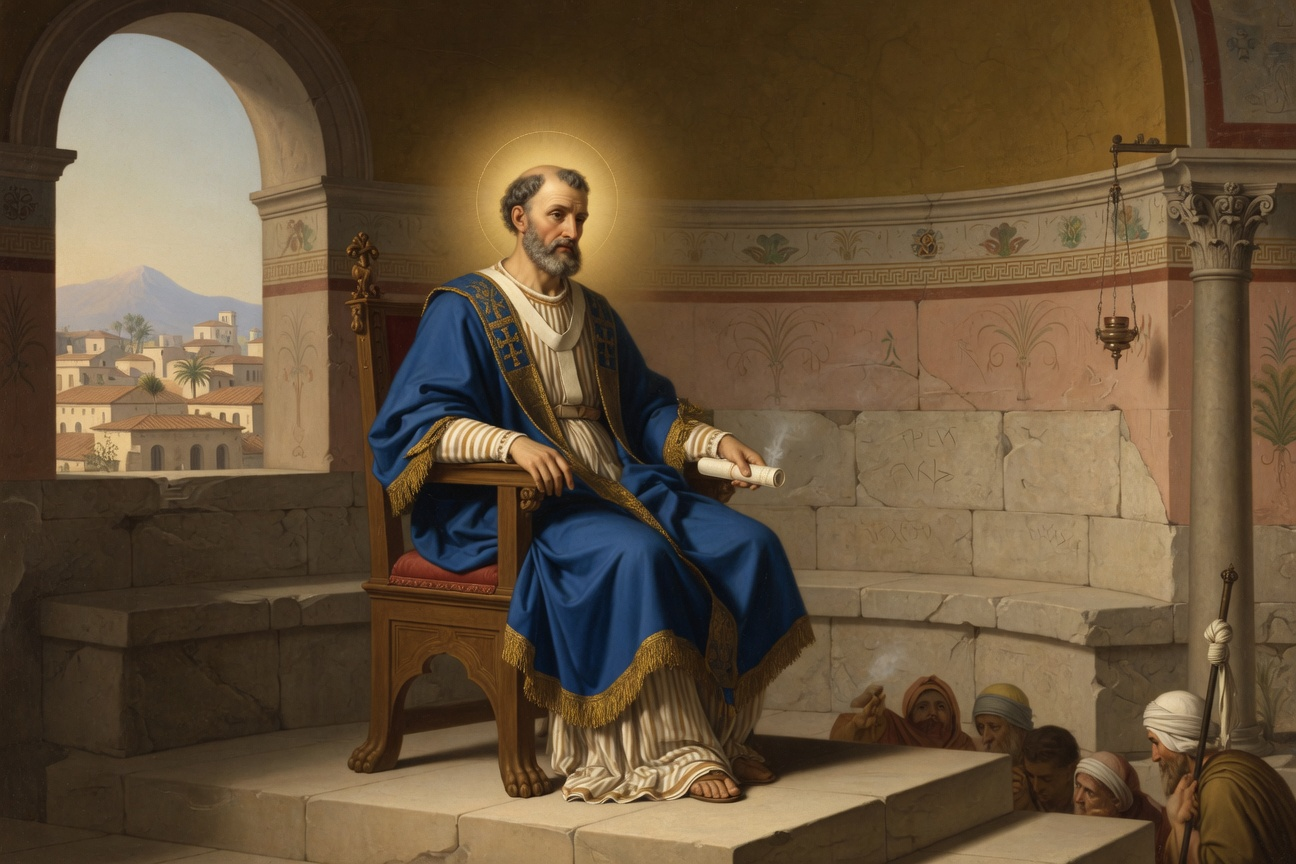
The Chair of Saint Peter at Antioch
This entry from the Petits Bollandistes explains the feast of the Chair of Saint Peter at Antioch, celebrated on February 22, and recalls the apostle's preaching in this city before his departure for Rome.
Contemporaries

Figures and markers around the normalized period for this entry.
Guided reading
2 reading sections
THE CHAIR OF SAINT PETER AT ANTIOCH
The Chair of Saint Peter at Antioch
“Peter is the organ of the college of Apostles, the axis and keystone of society.”
Saint Chrysostom, hom. LV in cap. XVI Matth.
This feast was instituted in memory of the preaching of Saint Peter, when the Apostles had learned the will of the Heavenly Father regarding the place to which each of them was called for the publication of the Gospel. The land of Syria having fallen to Saint Peter, he established his chair, and carried the word of God into Antioch, capital of the province: this happened no doubt through a singular guidance of Divine Providence, so that the first vicar of Jesus Christ, as pastor of the universal Church, might preach, in some manner, throughout the whole earth, by announcing the truth to the three nations that were the most considerable in the world: to the Hebrews, to the Greeks, and to the Latins. He had already exercised this pastoral function in Judea; he then passed to Antioch, where he did the same thing with regard to the Greeks for the space of seven years; after which, he took the road to Italy, in order to announce to the Latins the doctrine of his master, and to exercise, by this means, the office of universal pastor of souls.
The fruits of his preaching were so great in this city of Antioch, that (as we learn from the Acts of the Apostles) the name of Christians was there for the first time given to the faithful; before, they were called Nazarenes, or given names dictated by love or hatred.
The institution of this feast is very ancient, and several holy personages have made mention of it in all the centuries of the Church. Saint Ignatius, in the epistle he writes to the Magnesians; Ivo, Bishop of Chartres, in a sermon; the Council of Tours, which was celebrated in the time of Pope Pelagius (566); and, before all these authors, Saint Clement, Pope, in the tenth book of his Recognitions, treats of what happened to Saint Peter in the city of Antioch.
Source and editorial note
This entry reproduces the historical text of the Petits Bollandistes, proofread against the digitized pages. The traditions and assessments of the author belong to the period of the work.
Paul Guérin, Les Petits Bollandistes, volume 2, p. 618. Copy digitized by the Bibliothèque nationale de France: https://gallica.bnf.fr/ark:/12148/bpt6k307324
Editorial note: This entry presents the traditional explanation of the feast given by the Petits Bollandistes. The attributions of ancient texts and chronological indications are those of this edition.
Iconography
Signs and attributes
Frequently asked questions about The Chair of Saint Peter at Antioch
Who was The Chair of Saint Peter at Antioch?
This entry from the Petits Bollandistes explains the feast of the Chair of Saint Peter at Antioch, celebrated on February 22, and recalls the apostle's preaching in this city before his departure for Rome.
How is The Chair of Saint Peter at Antioch depicted in Christian art?
In iconography, The Chair of Saint Peter at Antioch is recognizable by: cathedra.
Which saints were contemporaries of The Chair of Saint Peter at Antioch?
Contemporaries include: Saint Martial, Apostle of Aquitaine, Saint James the Greater (Apostle), Saint George of Velay and Jesus Christ (Relics of the Passion).
Annexes & related entities
Structured data for exploration: events, miracles, quotes, places, attributes, patronages, and important entities cited in the text.
Key Events
- Establishment of the episcopal see in Antioch